
Somebody on a forum asked me recently which one to buy, the Meguiar's Ultimate Compound or the M105 Ultra Cut, and the honest answer is they are not fighting for the same spot on your shelf. You have already read a dozen reviews calling both of them great, and they are, which is exactly why you are stuck. One of these bottles is what you reach for on a Saturday afternoon with a foam pad and a faded hood. The other is what you break out when the paint has been through something and needs a real cut. I own both. I use one of them far more than the other, and it is not the bottle the pro detail shops stock by the case.
So the short answer first, because that is what you came for. If you are doing the work by hand, or you are new to a polisher, buy the Ultimate Compound. M105 Ultra Cut is a professional-grade abrasive built for a machine, and it will happily embarrass a hand applicator all afternoon while covering your driveway in dust. Keep reading for how I sorted them out side by side, and where I still reach for the rough bottle.
| Meguiar's Ultimate Compound | Meguiar's M105 Ultra Cut | |
|---|---|---|
| Cut power | Clears heavy oxidation, swirls and light scratches in a few patient passes | Stronger abrasives; chews through heavy oxidation and wet-sanding marks fast |
| By hand | Its home turf; works a foam pad without a machine in the other hand | Machine-only in practice; useless and dusty by hand |
| Work time and dust | Long, forgiving work time; dust wipes right off | Flashes and throws dust if you work it past its window |
| Clear coat and single-stage | Formulated to be safe on both, which covers most classics | Cuts both but demands real care; a thickness gauge helps |
| Wet-sanding mark repair | You will earn those scratches out by hand, slowly | The fast way out of a wet-sanding job on a machine |
| Entry price | A bargain at today's price for a 15.2 oz bottle | Sold by the quart and gallon for shops; a bigger buy-in |
| Learning curve | Forgiving; hard to hurt your paint the first time out | Assumes you already run a buffer on a regular basis |
| Best for | Faded paint, swirls and scratches on a weekend driver | Heavy compounding mid-restoration, on a machine |
Where Ultimate Compound Wins
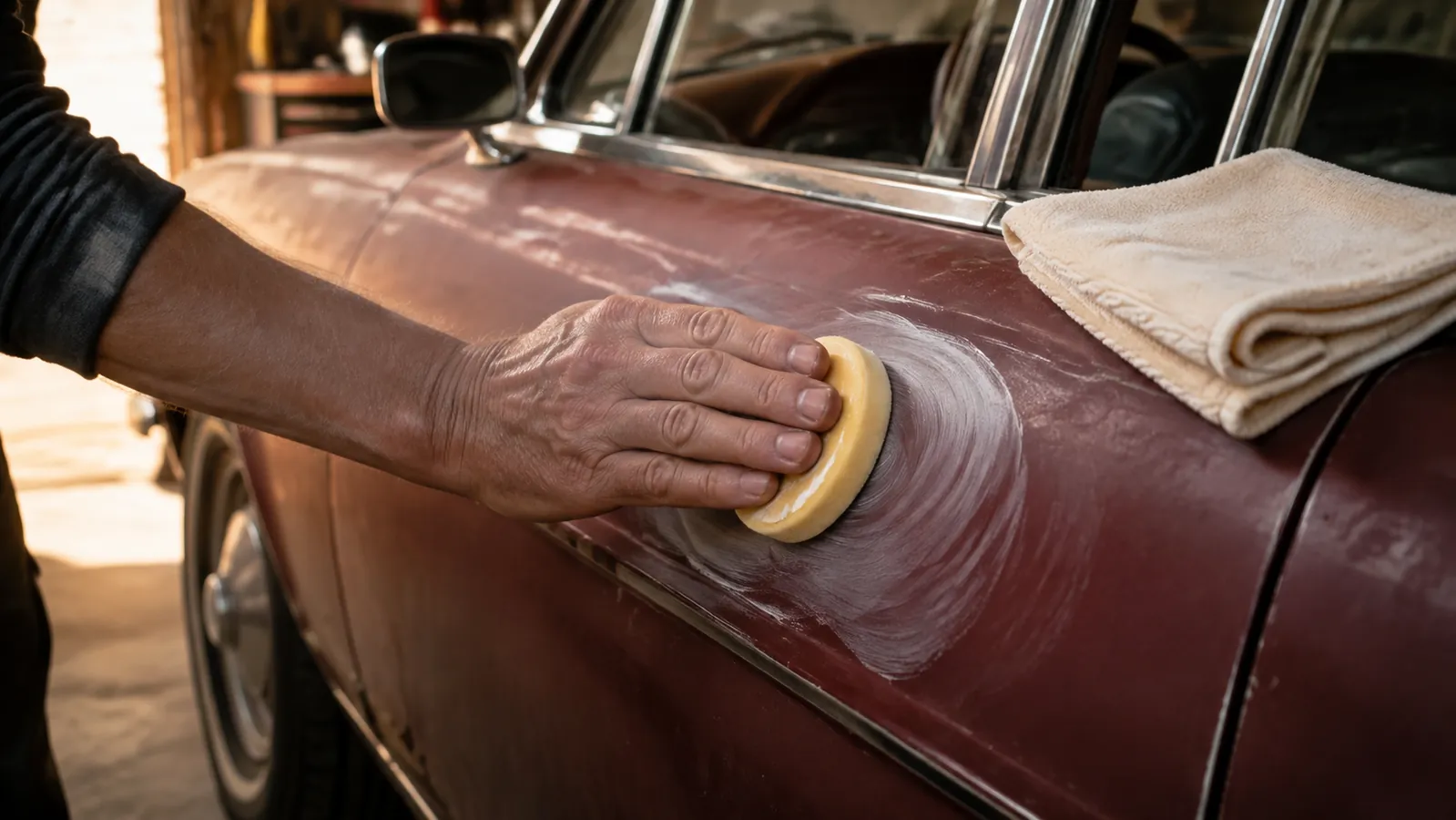
Any hand work, for starters, and there is plenty of hand work in classic car paint. The Meguiar's Ultimate Compound is one of the very few compounds that is honestly pleasant to apply by hand. It does not flash into concrete while you are still spreading it, it does not dot your fender with dust, and it breaks down evenly, so you are not chasing streaks with a second bottle afterward. On my old six-cylinder coupe, which wears original single-stage paint that has gone from fire-engine red toward salmon, nobody in their right mind lets a machine anywhere near it. Hand compounding is the only safe game in town, and this is the compound for that game.
It is also the right place to start when you are still learning what a compound is supposed to feel like. M105 will teach you, but it will teach you by taking a huge bite out of the paint before you know how hard to lean. The Ultimate Compound nibbles, and you can nibble your way through a breathtaking amount of oxidation before you ever need more bite. Most faded paint on most classics is sitting right inside its comfort zone, and that is the whole trick of it: it does enough of the job for almost everybody, and it leaves you paint to do it again next year.
Where M105 Ultra Cut Wins
When the paint has been through something, M105 earns its spot and then some. Wet-sanded a panel and the 2000-grit scratches still have to come out? That is M105 work. A respray that orange-peeled on a closed door, or oxidation so thick the hood reads flat white instead of red, or a scratch that catches your fingernail? M105 on a wool pad with a machine will go through those in one pass where the Ultimate Compound needs three or four, and the honest truth is the Ultimate Compound may never get there at all.
There is a whole world where the machine is the personality and the compound is just the flavor of the day, and if you live there, M105 belongs in your cabinet. It is a professional tool sold by the quart and the gallon for shops that compound cars all week. It respects a dual-action polisher and loves a rotary, and if you run a proper buffing station you will find it sharper and more predictable than the consumer bottles. Just understand you are signing up for its workflow, its flash times and its dust. None of that dust is anybody's favorite part of the job.
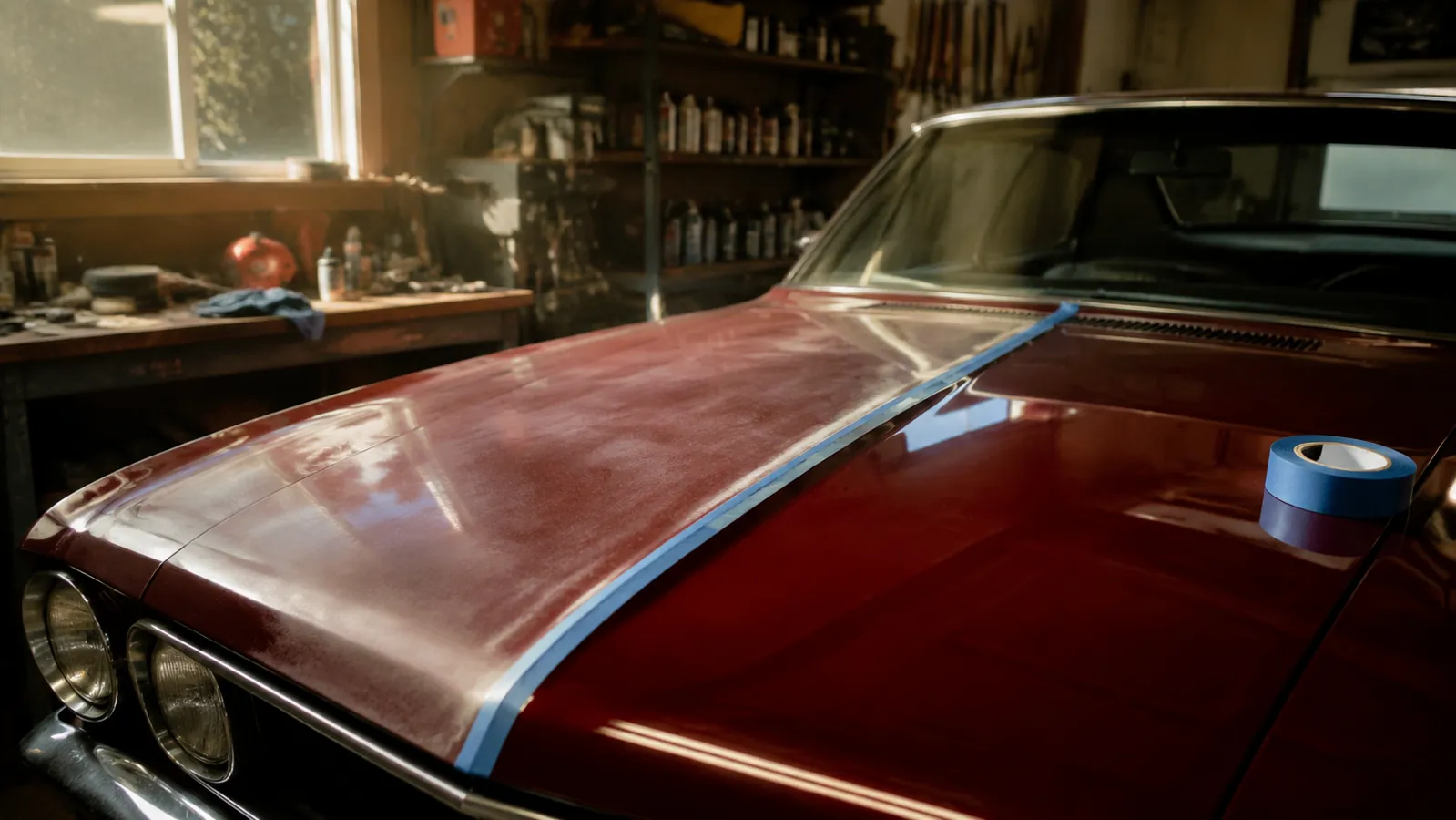
The M105 side of that hood came clean a full hour before the hand-cut side did. That is the whole trade in one line: speed for forgiveness.
The Bottle Most Garages Should Keep Handy
For faded paint, swirls and scratches, a bottle of Meguiar's Ultimate Compound and a foam pad are the cheapest restoration tool in the garage. It does ninety percent of what a classic's paint actually needs. Check today's price on Amazon.
Amazon Check Today's Price on Amazon →Who Should Buy Which
Buy the Ultimate Compound if your car is faded, swirly or scratched and you are going to do the work in your own driveway with your own two hands, or if you are still getting comfortable behind a dual-action polisher. It turns a thirty-year-old hood back into something that looks like it has been washed and dried properly. Most people reading this should buy this bottle. That is not a soft sell, it is an honest census of my own shelf.
Buy M105 if you already own a machine, you have cut a few panels without burning anything, and you have a specific heavy defect to clear: wet-sanding marks, deep scratch repair, or repaint texture you want gone. If you are standing in the aisle trying to talk yourself into the pro bottle, put it down. Your paint will tell you when you need it, and you will know, because the Ultimate Compound will stop getting the job done.
How I Ran Them Side by Side
Last spring a '60-ish F-series showed up with a hood that had spent twenty years parked under a pear tree. The paint was chalky and covered in fine scratches, the kind of thing that reads gray from ten feet away. I taped the hood straight down the middle, wrote a big L on one side and an R on the other in grease pencil, and worked the left half with Meguiar's Ultimate Compound on a foam pad by hand while the right half got M105 on a dual-action polisher with a cutting pad. Same hood, same paint, same weekend, and the same bent arm afterward.
That is not a perfectly fair race and I want to be upfront about it. One side got a machine, the other got my arm, and machines are not fair to arms. But that is exactly the point. The question was never whether the pro bottle cuts faster, it cuts faster. The question was how each bottle earns its keep in a garage that does not compound cars for a living, which is the garage most of you are standing in.
What the Two Bottles Actually Share
They are the same company, with the same quiet promise buried in the directions: start on a clean panel. Both of these Meguiar's compounds will mar a dirty panel all on their own, so the wash comes first no matter which bottle is open. Both also leave a haze behind, which means the step after compounding matters as much as the compound itself, usually a fine polish and then a wax. Skip that finish step and you will wonder why either bottle left you looking at ghosts.
And both bottles will sit on the shelf for a year between uses without going bad. None of these compounds have an expiration date worth worrying about, so there is no reason to hoard them. Buy for the job that is in front of you, not for the whole chemistry set, and you will not go far wrong with either one.
That shared shelf life is the quiet reason most garages end up with both. They do not compete for the same drawer, and once you own each, the only question left is which one reaches the bench first on a given Saturday.
The Ten-Minute Test
If you truly cannot decide, do what I did and quit reading for ten minutes. Pick the worst scrap panel on the car, the one you are half-ashamed of, grab a foam pad, and spend ten minutes on it by hand with the Ultimate Compound. If the oxidation lifts and color comes back, you are done shopping. Nothing about that test changes at the register, and it is cheaper than buying both bottles out of uncertainty.
If the paint simply will not give by hand, decide whether you actually own a machine and are willing to learn it, because that is the remedy, not necessarily a different compound. The misread I see over and over is people chasing a more aggressive bottle to fix an adhesion problem, a clear coat that is failing, or bare primer where the paint flaked off. No compound fixes any of those, and M105 will just chew the failure apart faster. When in doubt, the gentler tool tells you the truth sooner.
What the Bottles Will Not Tell You
Neither bottle comes with instructions that cover old paint, and old paint is why you are here. Work in small sections, a little larger than your foam pad, and let the abrasives do the cutting instead of leaning on them. Press too hard and both of these will smear and heat the panel without cutting, and on single-stage paint you can rub right through to primer before you feel the change under your hand. The pad should be doing the moving, not your shoulder.
And budget for the cleanup. Both compounds leave a residue that hides the swirls until you wipe it off, so keep a clean folded microfiber and flip it often. On M105 that residue flash-dries fast and can dust onto black trim, so tape the molding before you start. None of that is printed on the label in my words, but it is the difference between a good compound job and a haunted one.
The Bottom Line
Same brand, different jobs, and eventually a garage should probably have eyes on both of them. But if I could only keep one on the bench, and I have already made this choice, it is the Meguiar's Ultimate Compound. It does ninety percent of what my cars need, it does it without a machine in my hand, and it does not leave a cloud of dust settling on Brutus and Dottie, who lean on the bumper every time I work. M105 sits on the top shelf. It has not been hungry in a while.
One more thing, because it costs me nothing to say it. If a shop quoted you a price to cut and polish the whole car, you can rent the machine, buy the Ultimate Compound, and do most of it yourself across two weekends, and the paint bill drops to pocket change. M105 does not change that math for a hobby garage. It becomes interesting when the work outgrows your elbow, not before.
One Bottle, a Saturday, a Better-Looking Hood
My method never changes: wash it, tape off a small section, work it with a foam pad, wipe it, move on. A bottle of Ultimate Compound covers the whole afternoon. See today's price on Amazon.
Amazon Check Today's Price on Amazon →