
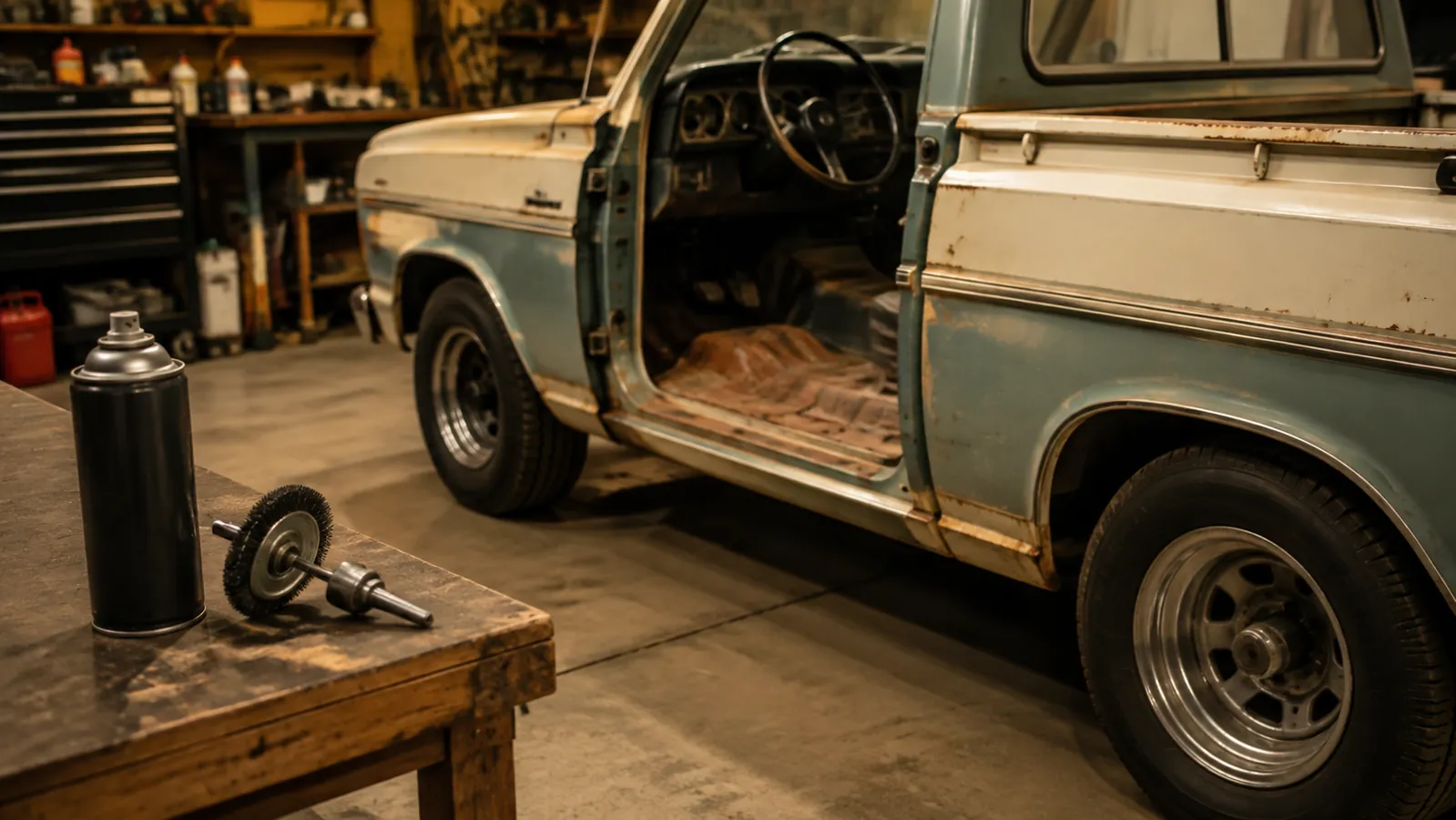
Somebody calls me every spring with the same question, usually while staring at a frame rail or a floor pan going orange. Should I hit it with Rust-Oleum Rust Reformer or a bottle of Ospho? I have used both until my knuckles were raw, and the honest answer is that they are not two brands fighting over the same drawer. One is a paint that converts rust while it coats the metal. The other is a liquid treatment that converts rust and hands you a surface that still needs primer. Both earn their keep, but you reach for the right one based on whether the car is still assembled and you want it sealed this afternoon, or the metal is bare and you are building the foundation for a real job.
Short version first, because that is what you came for. Light surface rust on a part you are not pulling off the car? Wire-wheel it, spray on the Rust Reformer, and you can be driving before supper. Frame out on stands with bare steel and a gallon of epoxy primer waiting? Ospho is the better place to start, and you prime right over the gray film it leaves. The black spray can and the liquid bottle are not rivals. They are different steps on the same ladder, and knowing which rung you are standing on is half the work. The other half is prep, which is the same thing I tell myself every time I climb under a wing rib with a brush.
| Rust-Oleum Rust Reformer | Ospho | |
|---|---|---|
| Upfront cost on a big job | A few dollars a can at today's price, and a frame eats several cans | One gallon costs more up front but covers a whole frame and then some, and it dilutes |
| Gets into seams and pinch welds | Coats the surface you can see and stays there | Wicks into laps, seams, and spot-weld flanges a spray can cannot reach |
| Seals the metal in one pass | Converts the rust and dries to a black paintable coat, so the part is sealed when it is dry | Converts to a gray phosphate film that still needs primer and paint on top |
| Reach into tight spots | Comfort tip sprays from any angle, upside down into inner fenders and rocker ends | You are brushing, rolling, or wiping, so awkward corners are a fight |
| Holds until you topcoat | Dries to a coating, so a treated pan can sit for weeks before paint | Bare phosphate can flash rust in humid air if it sits too long |
| Primer needed afterward | No; the coat is your base, topcoat it the same day or leave it | Yes; it is a treatment, not a finish, so primer goes on top |
| Best on | Wire-brushed surface rust on a car that is still together | Freshly stripped bare steel and weld-through prep before epoxy primer |
Where Rust-Oleum Rust Reformer Wins
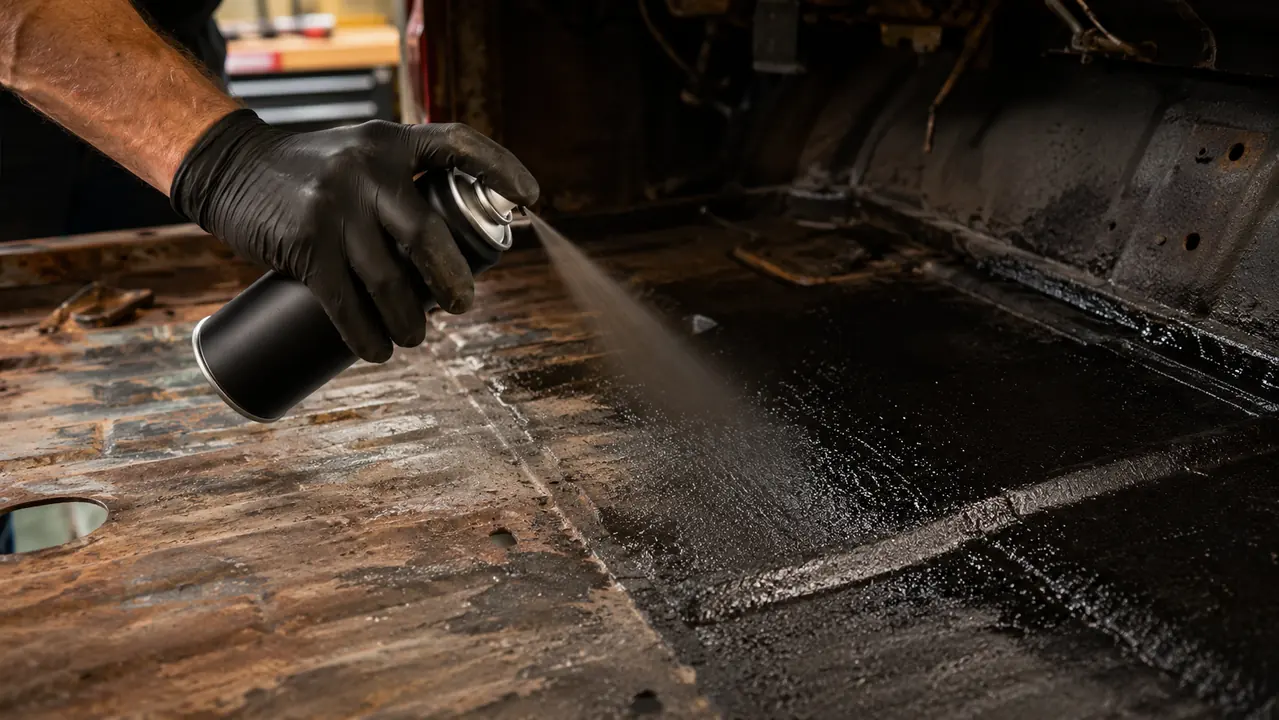
Rust Reformer wins any day the car is still together and you want the rust dead and sealed in one trip. That is its whole personality: a paint with rust-converting chemistry built in. You knock the loose scale off, spray it on, it goes on black and dries black, and the rust underneath is chemically locked. You can topcoat it the same day with whatever you are shooting, or leave it as the finished surface on the underside of a car nobody is judging. On a driver that lives out in the weather, I have had reformer-treated spots go years without the rust coming back through.
Where it really shines is the spots you cannot get a brush into. The comfort tip sprays from any angle, so you can hit an inner fender, a rocker end, or the back side of a core support upside down and still lay down a clean coat. That matters on an old truck like my F-series, where pulling the cab off to do it 'right' turns a weekend into a summer. Brutus, my bulldog, is a fan too, because he gets to keep standing guard at the workbench while I am under the car, instead of watching me scrub a corner for three hours. He is a practical dog.
Now the fine print. It converts light surface rust, and the can is honest about that. It will not resurrect metal that is already flaking in layers, and it will not fill pitting. If you wire-wheel a floor pan and find real pits, the reformer will lock the rust in the bottom of those pits, which is exactly what you want before a topcoat. But if the metal is thin enough that your wire wheel punches through, you have a patch panel project, not a rust treatment project. Know the difference before you spray.
Where Ospho Wins
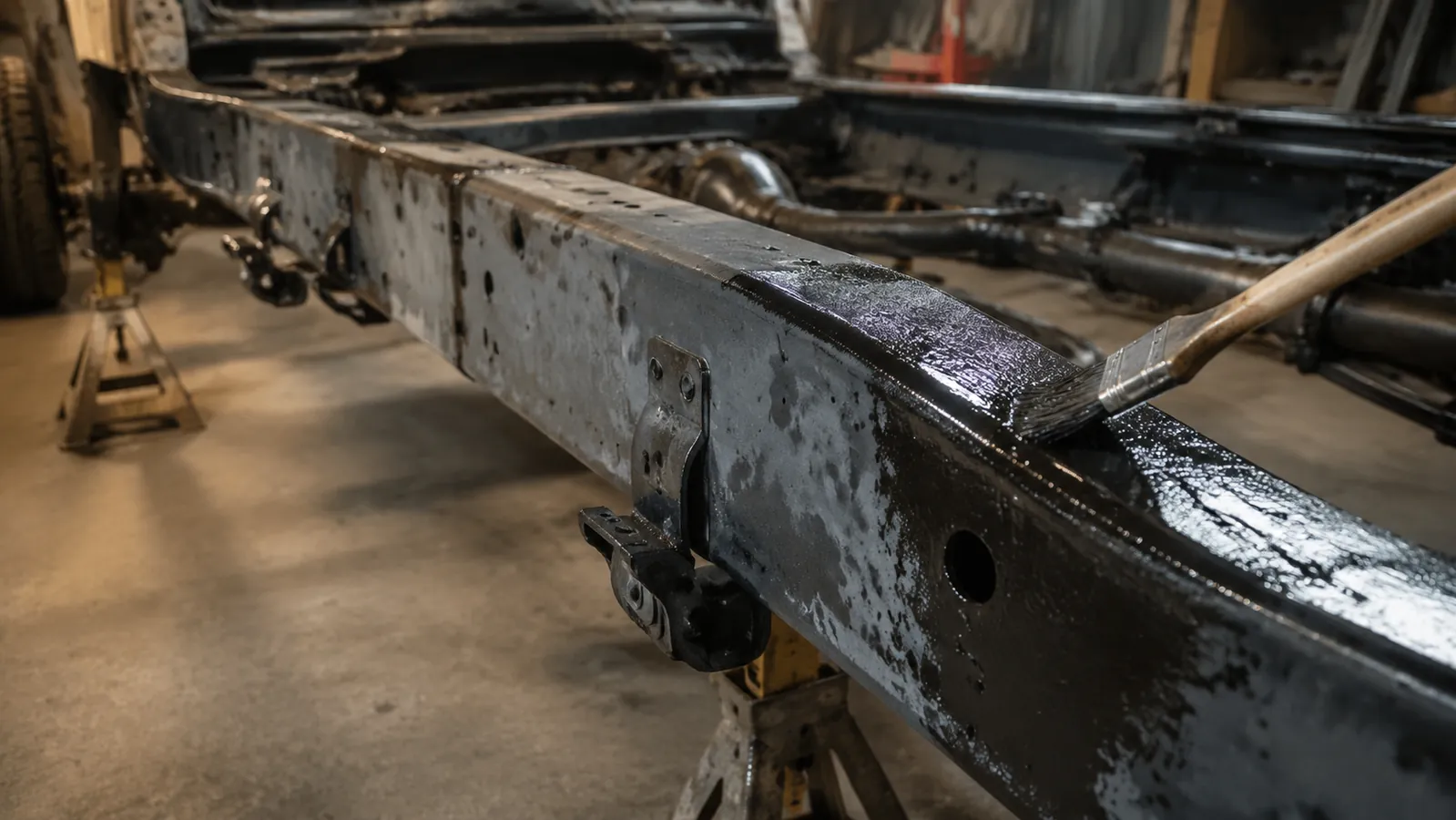
Now the bottle, because Ospho wins some fights and I would be lying if I said otherwise. It is phosphoric acid, the old shop standby, and it earns its keep on bare metal at scale. When the frame is out of the car and sitting on stands, a gallon of Ospho, diluted and brushed or wiped over the whole thing, treats every square foot for a fraction of what the spray cans would run. You let it dry to that light gray phosphate film, then primer goes down on top. For a full frame, a stripped body shell, or anything you are doing a real restoration on, the liquid is the cheaper and more durable starting point.
It also gets into places a spray can physically cannot. It is a liquid, so it wicks into seams, laps, and spot-weld flanges, which is the same reason it is a favorite for weld-through prep on aircraft: the stuff follows the joint line. Honestly, if you are putting epoxy primer over a properly stripped frame, Ospho is the more correct base. The spray can is a sealer. Ospho is a foundation. They are not interchangeable, and when you are standing in front of a bare frame, you want the foundation.
Its weakness is the same as its strength. Ospho leaves no protective coating, so a treated panel left bare in a humid garage can flash rust before you get primer on it. I have done exactly that and watched the gray film blush orange by the next weekend. You plan around it: treat, then prime before the weather turns. And the metal has to be clean first. Heavy scale has to come off mechanically before you brush it on, same as with the spray can.
The spray can is a sealer. Ospho is a foundation. When you are standing in front of a bare frame, you want the foundation.
The Can That Seals Rust in One Afternoon
For spot rust on a car that is still assembled, Rust-Oleum Rust Reformer is the fastest honest fix I know: wire-wheel, spray, topcoat, done. It does the whole job while the car stays on its wheels. Check today's price on Amazon.
Amazon Check Today's Price on Amazon →Who Should Buy Which
If you are reading this because there is an orange patch on your daily driver, buy the Rust-Oleum. You want the rust dead and the metal sealed without disassembling your life. If you are reading this because you have a frame on stands and a gallon of epoxy waiting, buy Ospho. You want the cleanest possible base before you lay down the expensive stuff.
There is a middle path, and it is the one I actually run. Ospho on the bare metal I am priming for keeps, Rust Reformer on the spots I am sealing in place on a car that still has to go to work on Monday. Both stay on my shelf. They are not competing for the same drawer.
How I Ran Them on a '66 Frame
Last spring I did the front half of a '66 F-Series frame that had been sitting under a tarp since before I bought it. The rails were covered in tight surface rust, nothing structural, just orange from years of dew and neglect. I spent a morning with a cup brush knocking the scale off the rails and the crossmember, then taped off the steering box and the lines I was not touching. On the frame rails themselves I used Ospho, brushed on, because I wanted the cleanest base before the chassis paint. On the inner fenders and the firewall, I used the Rust Reformer spray, because those are spots I could never brush properly and I wanted them sealed in place.
Four months later the truck has lived outside under a carport, and both treatments are holding. The Ospho spots are under two coats of chassis black, and the reformer spots are still black and tight. Neither one failed, because neither one was asked to do the other one's job. That is the whole review in a sentence: match the tool to whether you are sealing or building.
Caveat, and it is an important one: this was a dry, tight rust situation, surface corrosion, not cancer. If a rail is flaking in sheets or you can push a screwdriver through it, no chemistry on earth saves that, and both products will happily be painted over a hole you should have patched. I have bought a replacement floor pan off the results. The can and the bottle are rust treatments, not body shops.
The Prep That Makes Either One Work
Here is the part nobody wants to hear, and the part that decides whether any of this works. Both products only do their job on metal that has had the loose stuff knocked off. I wire-wheel down to where the rust is thin and tight, wipe with a rag, and let it dry. On a big frame I use a cup brush on a grinder. On a floor pan, a drill and a three-inch wheel. You are not chasing bright shiny steel, you are getting down to rust that is still bonded. The chemistry in both has to touch the rust to convert it. Paint over loose scale and you have sealed the rust in alive, and it will win, because rust always wins an argument it is allowed to keep having.
One more thing that bit me early: do not treat rusty metal that is wet. Both products need a dry surface, and Ospho in particular acts differently with moisture underneath. I do rust work on a dry day or after the car has sat in the shop overnight, and I wear gloves. Phosphoric acid is not a hand lotion, and the spray can does not care where it lands either. This is the boring stuff that separates a job that lasts from a job you redo next year. It is the same reason I prep a wing rib before I rivet it. Prep is the part you do not get to skip.
What the Can and Bottle Won't Tell You
Neither label explains how much a wire wheel matters, and neither label will tell you that both products fail in the same place: on metal that was never cleaned. I have also learned not to treat rust on a humid day, because the film will flash rust before you get paint over it. Do this work on a dry day and you remove most of the risk for free.
And understand what you are buying. The Rust Reformer is a finish in one pass, but it is a flat black finish, so if the part shows, you are topcoating anyway. Ospho is never a finish, it is a step. Neither one turns a rusty frame into a show car. They turn a rusty frame into a part that is not rusting anymore, which is the whole job.
The Bottom Line
Same argument every spring, same answer: buy for the job in front of you. If the car is still assembled and you want the rust dead and sealed this weekend, Rust-Oleum Rust Reformer is the tool, and it earns its spot on the shelf. If the metal is out and you are building a proper foundation, Ospho is the better starting point, and you prime over it like it is a step, because it is. I keep both on the same shelf, Dottie snoring underneath it, and I have not lost a floor pan to rust in years.
Whichever you choose, the expensive part of the job is not the can or the bottle. It is the prep you skip, and I have paid for that mistake more than once. Knock the scale off, treat dry metal, and topcoat before the weather turns, and both of these will do exactly what they say.
One Can, a Wire Wheel, a Saturday
For spot rust on an assembled classic, the Rust Reformer is what I reach for most weekends. Wire-wheel, spray, topcoat, done, while the car stays on its wheels. See today's price on Amazon.
Amazon Check Today's Price on Amazon →