
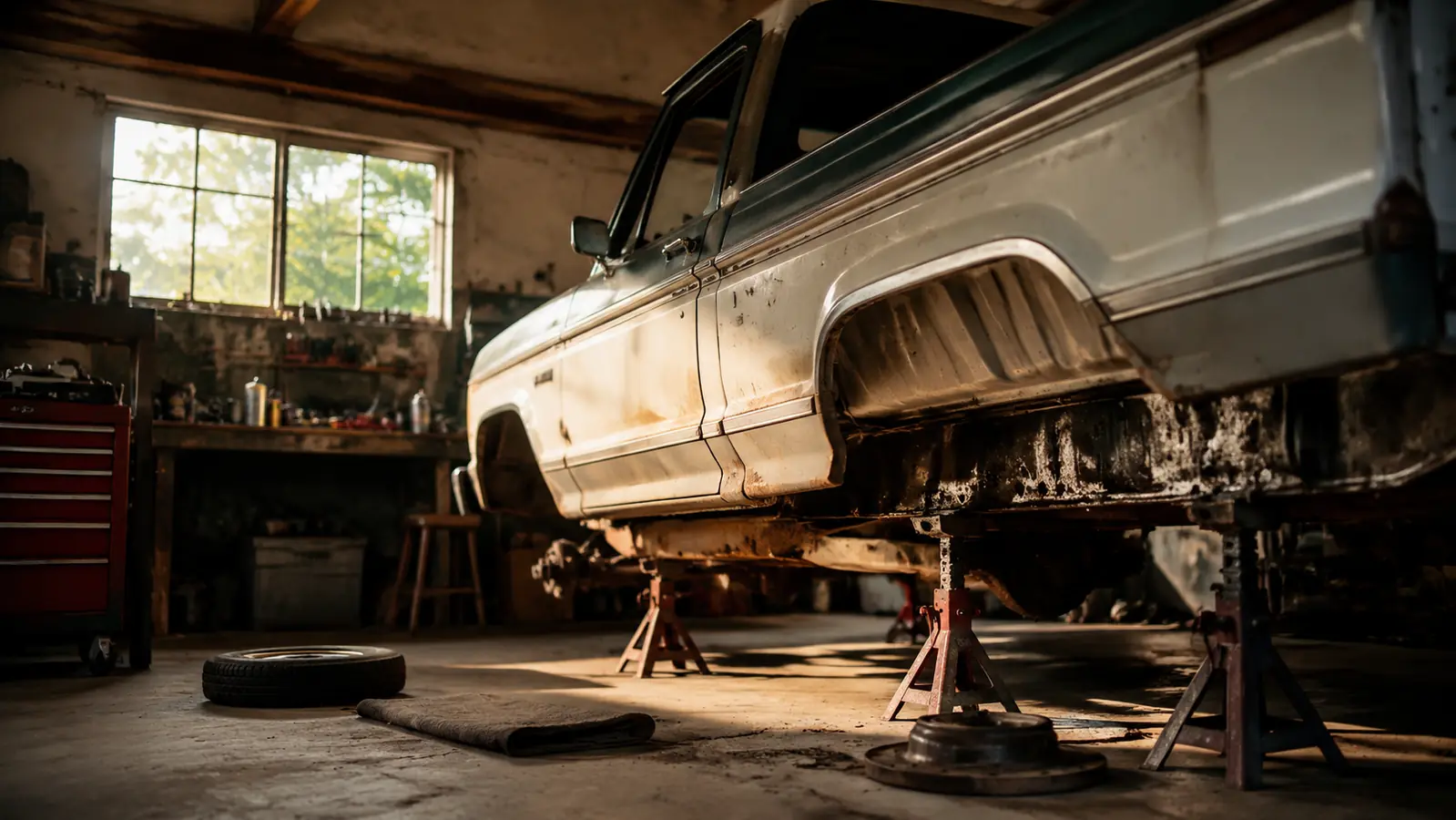
Rust is the one part of an old car that never waits for you. You can sit on a body project for a year and the paint will hold still while you think about it, but the metal under the floor mat will not. I learned that the hard way on a '60 F-100 I've been working through in the back of the garage, a truck that spent twenty years parked under a pine tree. When I finally pulled the rubber mat out of the cab, the driver's side floor pan had gone from a little flush of brown to something I could flex with my thumb, and my first honest thought was that I was looking at a cut-and-weld job and a weekend I did not have.
That's the fork every old car reaches eventually. Either you cut the rust out and weld in clean steel, or you grind it down, treat what's left, and seal it so it can't spread while you figure out how deep the project really goes. I've done both, and for the patches of surface rust that haven't eaten through yet, the Rust-Oleum Stops Rust Reformer has been the can I reach for more than anything else in the cabinet. I'm not going to tell you it transforms a car, because it doesn't. Two years and a dozen projects later, here's the honest version of what it does, what it doesn't, and where I still wouldn't trust it.
The Quick Verdict
The best cheap rust stop in the garage for surface rust that hasn't eaten through yet. It converts the rust to a stable black finish and seals it, but it is a prep product, not a miracle, and it will not save metal that's already rotten.
Amazon Check Today's Price →Have Surface Rust on a Floor Pan or Frame Rail? This Is the Can That Stops It Cold
Rust-Oleum Stops Rust Reformer converts light surface rust into a paintable black finish and seals it so it can't spread. I've used it on frames, floor pans, and inner fenders for two years. If that's what you're staring at, grab a can before you start spinning the wire wheel.
Amazon Check Today's Price on Amazon →How I've Used It
Over the last two years the reformer has been on the F-100's floor pans, a frame rail on an old Chevelle that lived in a damp barn, the inner fenders of a '66 Mustang someone parked with a leaking battery, and a battery tray on my Thunderbird that had gone more brown than gray. I've also used it on stuff that isn't a car at all, a bench vise, a set of jack stands, and a trailer tongue that spent one winter too many sitting on the gravel. It costs around nine dollars a can, so I buy it by the three-pack and keep it in the cabinet.
The way I've settled into it is simple. When I find rust that's still surface level, where the metal underneath is solid and the rust hasn't eaten any real thickness, the reformer is the first can off the shelf. I don't use it on anything structural that's already thin, and I don't use it where a patch panel is the honest answer. But for the orange bloom that shows up on frames and floors every spring, it earns its keep, and it does it in an afternoon.
Brutus, the older bulldog, has decided the whole operation is a spectator sport. He sprawls on the concrete next to the jack stands and watches me wire-wheel like he's keeping score, and he's not wrong that most of the work down there is patience. I try to keep the spray away from him, because neither of us needs a bulldog that smells like a chemical experiment.
How Rust Reformer Actually Works
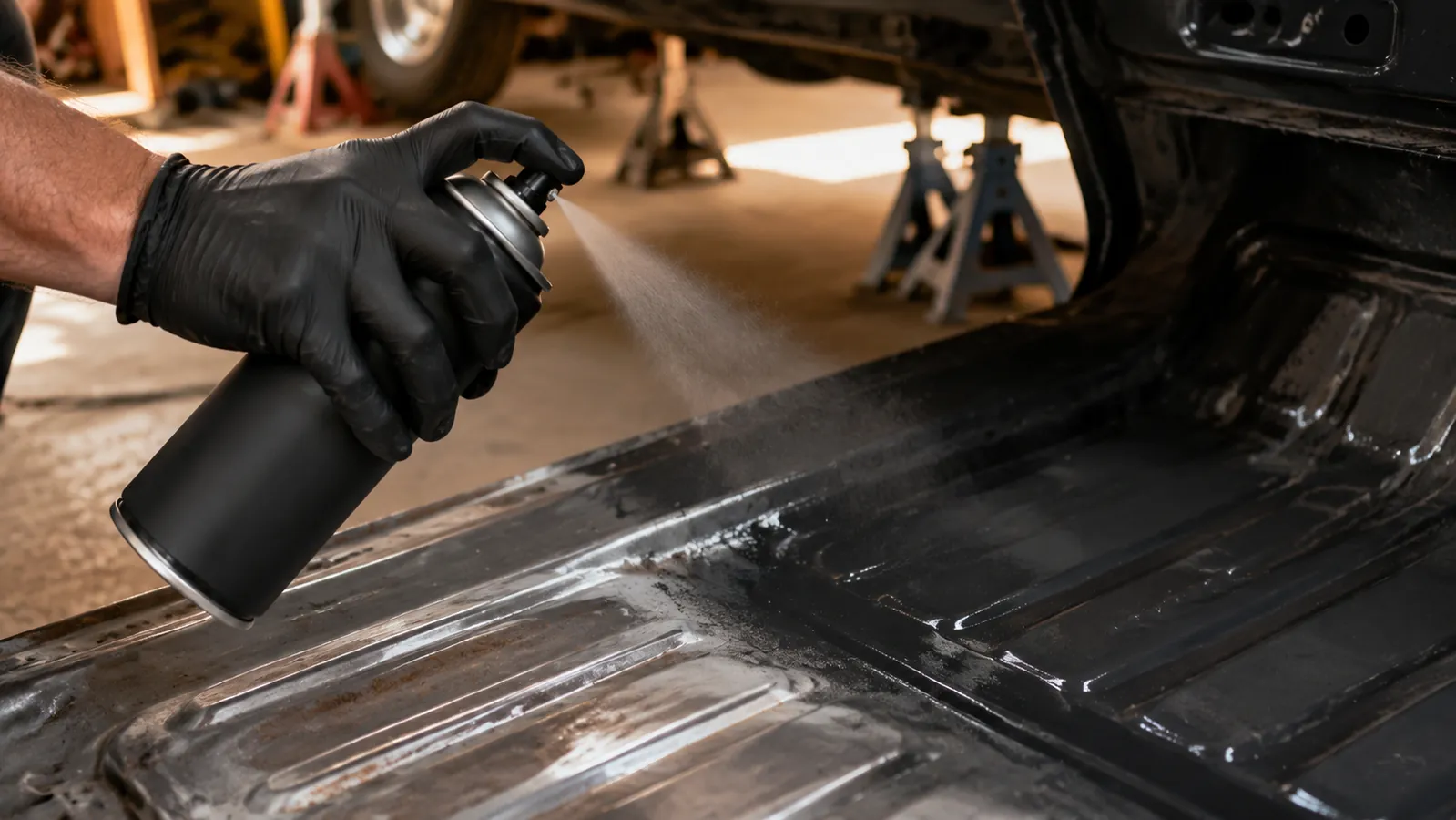
The short version is that it's a spray paint with a rust converter built into it. Instead of just covering the rust with a colored film the way a normal paint does, the active ingredient reacts with the iron oxide and turns it into a black, inert compound that has no interest in oxidizing any further. The can says it 'converts rust into a paintable surface,' which is marketing-speak for: it chemically stops the reaction and leaves you a stable black coating you can paint right over.
That matters because the normal way most people handle rust, which is to wire-wheel it down to shiny metal and spray on primer, leaves rust in every little pit you can't reach with the wheel. Primer over a clean-looking surface is fine until the rust you couldn't see starts blooming back through in six months. The reformer is for that metal, the pitted spots where the wheel only touches the high points and the brown stays down in the low ones.
The honest limit is that it only works on rust it can actually reach. Light surface rust, the powdery orange kind, it soaks into and converts completely. Heavy scale, the flaky stuff that flies off when you tap it with a screwdriver, has to come off first. The converter can't penetrate a thick layer of scale, it just coats the top of it and the rust keeps eating underneath. That's where people get burned and blame the can, and the can doesn't deserve it.
Two Years on Frames, Floor Pans, and Inner Fenders
The F-100 floor pan is the best test I've got. I wire-wheeled it in the spring of the first year, hit it with two light coats of reformer, and left it as-is for about eight months while I worked on the other side of the truck. It sat that whole time in a garage that isn't climate controlled, same damp that rusts everything else in it. When I finally got around to topcoating it, the converted surface was still black and tight, with no orange bleeding through anywhere. That's the result the can promises, and it delivered.
The inner fender under the leaking battery was the harder case, because battery acid and the crust it leaves behind behave differently than plain rust. I neutralized the acid with a baking soda and water wash first, let it dry completely, then wire-wheeled and reformed it. It's held for a year and a half with the battery back in place. The lesson is the one that keeps coming back across every project: Rust-Oleum's reformer is excellent at its job, and its job starts after you do the prep.
It let me down exactly once, and I want to be honest about that. A frame rail on that Chevelle had been rusting from the inside out. The outside looked like ordinary surface rust, but when I started knocking the scale off with a hammer, chunks came away and I could see the metal had gone thin in places. I reformed it anyway because it was cheap and I was mid-project, and it looked great for a few months. But the rust was already through, and no converter in the world rebuilds metal that's gone. That rail is getting cut out this winter, and that failure was never the reformer's fault.
Eight months in a damp, unheated garage, and the converted floor pan was still black and tight with not a drop of orange bleeding through.
The Prep Work Is 80 Percent of It
Here's the part that isn't on the can. The reformer does not forgive bad prep. If you spray it over flaking scale, or over grease, or over a surface that's still wet, you are just painting over a problem and the rust will keep eating underneath the new coat. I've made every one of those mistakes so you don't have to, and each one cost me a redo.
The routine that works for me: knock the loose scale off with a wire wheel on an angle grinder, or a stiff wire brush for the tight spots. Get down to where the rust is brown and fairly even, not flaky. Blow it off with compressed air, or wipe it with a clean rag and some degreaser, and let it dry completely. Then spray two light coats about ten minutes apart, using the comfort tip, which lets you hit awkward angles without flipping the can upside down. It dries fast, which matters on a damp fall day in a garage.
The other trap is temperature and humidity, and it's the airplane guy in me that keeps harping on it, because prep and dry conditions are the whole game there too. Like any spray can, it doesn't like the cold, and it doesn't like humidity. I've had it go on streaky and sit tacky for a long while on a humid summer afternoon. On a warm, dry day it's a completely different product. You can paint over it in about an hour, but I've learned to let it sit overnight whenever I can swing it.
What to Paint Over It
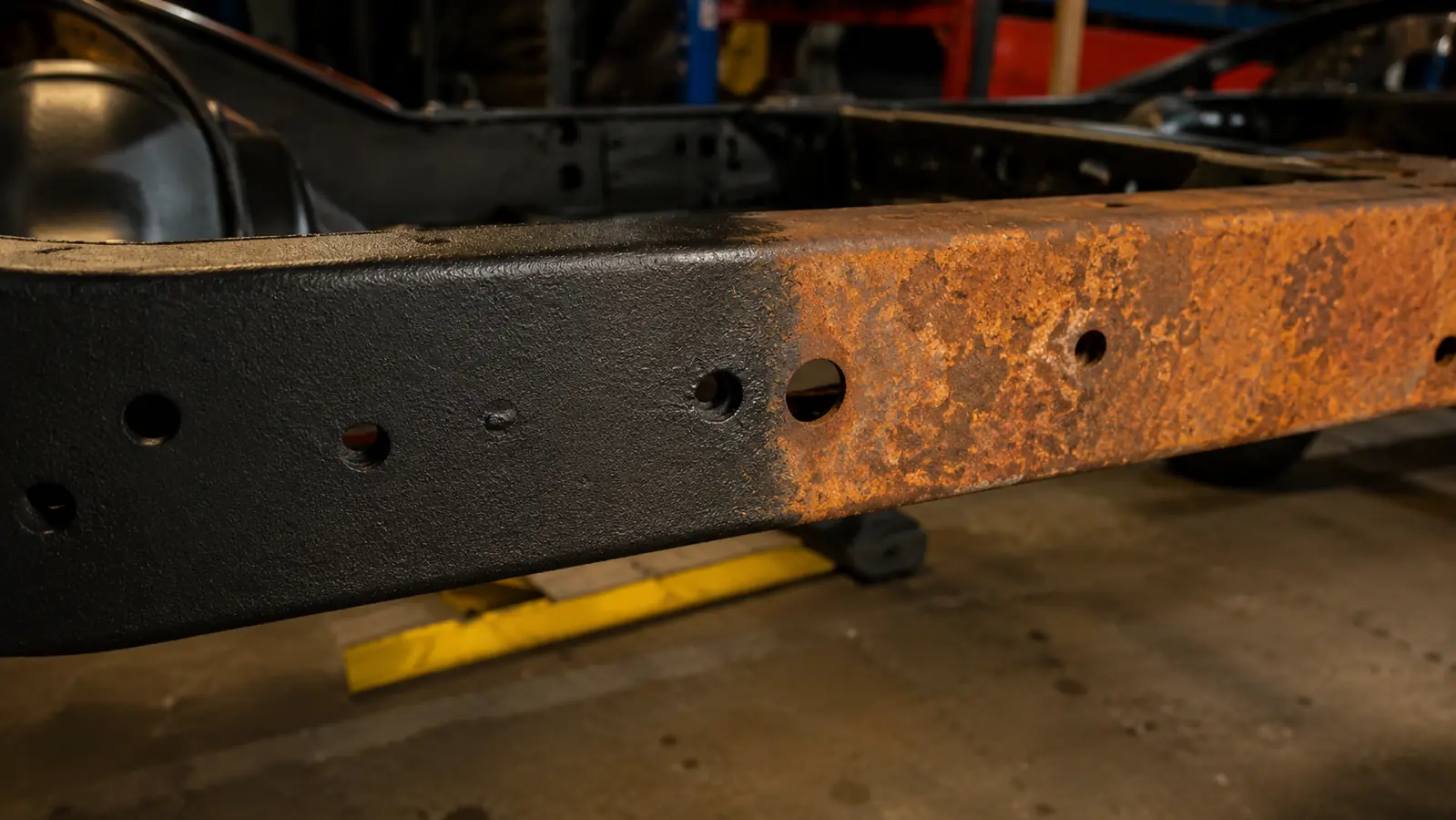
The Rust-Oleum reformer leaves a flat black coating, and you do not have to paint over it at all if black is fine with you. On a floor pan, a frame rail, or the underside of a body, I've left it as-is and it's been fine. It's a perfectly legitimate final finish for the places nobody sees, and it's cheaper and tougher than most of what you'd put on top of it.
If you want a color topcoat, the sequence that's worked for me is reformer first, then a proper primer, then your paint. Some folks skip the primer and go straight to paint and it mostly works, but I've had better luck with the primer in between. It also matters what's underneath. If the wire wheel broke through to bare steel in spots, that bare metal still needs a real primer or a second coat of reformer, because the reformer isn't a substitute for etching primer on virgin steel. Planes taught me the same rule: you don't skip the layer that holds the next layer.
Alternatives I've Tried
The main alternative is Ospho, a phosphoric acid liquid you brush or spray on and let react, and it's a fine product for a different job. I ran it side by side against Ospho on a rusty frame and both stopped the rust about the same. The difference is the finish. Ospho leaves a grayish metallic surface that really wants a topcoat, while the reformer leaves a black coating that can stand alone. For a floor pan or frame I'd rather have the reformer's finish and seal in one step.
I've also used a proper rust-sealing paint like POR-15 on a frame, and it's excellent, but it's a different animal. It's pricey, it needs its own prep, and it's a whole production for a job that might just be a floor pan with a palm-sized patch of rust. For small surface rust, calling up POR-15 is like firing a cannon at a squirrel. The reformer is the proportionate tool for ninety percent of what a garage restorer actually finds.
And the old standby, just wire-wheeling everything down to bare metal and priming it, has its place, but it leaves those pits full of rust I mentioned. I still do it on virgin steel that's never rusted. But the moment there's brown down in the grain, I reach for the Rust-Oleum reformer instead. There are a dozen reasons a rust reformer earns its keep in a restoration garage, but the first one is simply that it turns a three-hour grinding session into a forty-minute one.
What I Liked
- Turns surface rust into a stable black finish instead of just covering it up
- Cheap enough to buy by the three-pack and keep one within reach
- Dries fast and sprays at awkward angles with the comfort tip, no need to flip the can
- Genuinely stops the rust from coming back under a topcoat when the prep is right
- Works as a final finish on floor pans and frames with no topcoat needed
Where It Falls Short
- Will not penetrate heavy scale or rust that's already eaten through the metal
- The result is only as good as your prep, and it punishes sloppy prep hard
- Needs a neutralized, dry surface; battery acid and grease will defeat it
- Flat black only, so a color topcoat means extra primer and paint steps
- Cold or humid conditions make it go on streaky and dry slow
Who This Is For
If you've got a classic with surface rust on floor pans, frame rails, inner fenders, or anywhere the metal underneath is still solid, this is your can. It's also for the guy who finds a little rust bloom every spring and wants to deal with it in an afternoon instead of tearing the car apart. If you do your own work and you've got a wire wheel and half an hour, this is the cheapest rust insurance in the garage. I'd hand it across the driveway to a neighbor before I'd hand him a torch.
Who Should Skip It
Skip it if the metal is already thin, if you can push a screwdriver through the rust, or if you're looking at flaking scale that's been building for years. Skip it if you expect to spray over a dirty, damp surface and have it work, because it won't. And if the rust is coming from the inside of a panel, or it's structural rot in a frame, no can of anything is the answer; that's cut-and-weld territory. This is a surface-rust tool, and it is not a miracle, and any can that promises to be one is lying to you.
Keep a Can of Rust Reformer on the Shelf
For surface rust that hasn't eaten through yet, Rust-Oleum Stops Rust Reformer is the most honest rust tool I own. It stops the spread, gives you a paintable black finish, and costs about what a fast-food lunch does. If that's the rust you're staring at, get a can and do the prep right.
Amazon Check Today's Price on Amazon →