

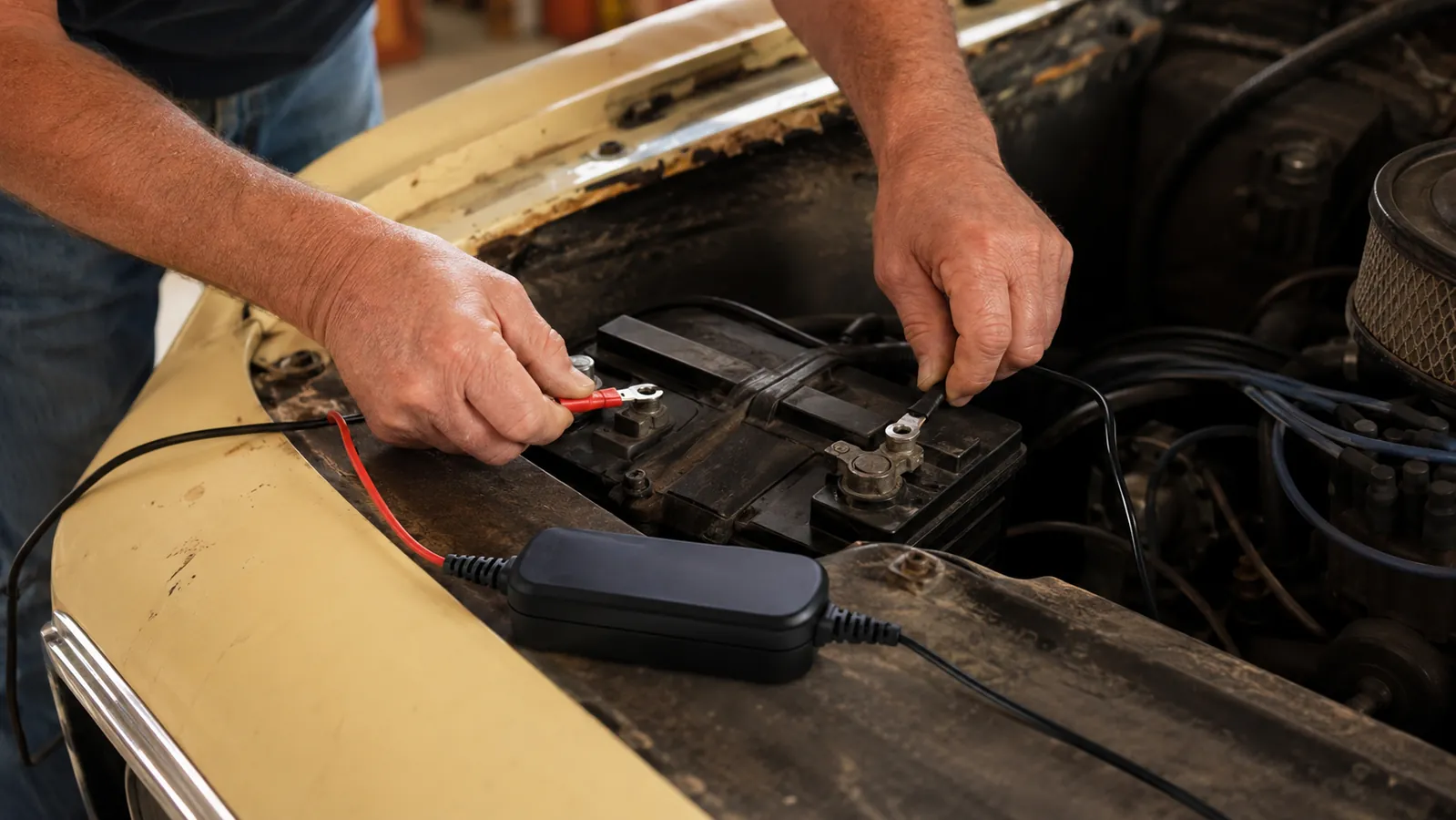
Nothing in the hobby sounds quite like a dead battery in March. You walk out to the garage on the first warm Saturday, go to fire the coupe, and instead of a crank you get one flat click from the solenoid, like the car is daring you to push it up the driveway. I lived that ritual for years before I got serious about battery maintainers. Two winters ago I stopped guessing and ran the test you are probably running right now: I put a NOCO GENIUS1 on two cars, put a Battery Tender Plus on the third, and left all three plugged in through a whole Michigan winter to see which one I actually trusted by April.
Here is the short answer so you do not have to earn it the hard way. If you own anything with a six-volt electrical system, a lithium battery, or a battery that sits long enough to sulfate, buy the NOCO GENIUS1, full stop. If every vehicle you own is twelve-volt and you want the simplest, most proven box with the longest warranty, the Battery Tender Plus is still a good buy and I will not talk you out of it. The rest of this is the evidence for that split, plus a few honest things I learned leaving both plugged in all winter.
The setup was as fair as a garage test gets. The 1954 six-volt coupe ran on the GENIUS1 in 6V mode. The 1960 F-series sat on the second GENIUS1 in 12V. And the Thunderbird, which belonged to nobody in particular and so belonged to me, lived on the Battery Tender Plus, which is exactly how the yellow box likes to be used. All three batteries were lead-acid and in good shape going in, and the garage bounced between the high twenties and the mid-forties all winter. I checked resting voltage once a month with the same meter, mostly out of habit, because the whole point of a maintainer is to stop thinking about the battery.
The Two Specs That Actually Matter
Before the marketing noise, two things decide which of these you want: what kind of batteries you own, and how long you need the box to keep doing its job. Amp rate gets all the attention because it is a number, but for a car parked all winter, 1 amp and 1.25 amps are both plenty. Neither of these is a charger you use to bring a deeply dead battery back in a hurry. They are float chargers. Their whole job is to hold a good battery at full charge, and both of them do that without complaint.
What actually separates them is voltage and battery chemistry. The GENIUS1 speaks six-volt and it speaks lithium, and the Battery Tender Plus speaks neither. That is not a knock on the yellow box; it is a design that has not needed to change in decades because it does one job perfectly. But for a guy restoring old iron, six-volt support stops being a spec the day you buy a car built before 1955. That is the exact moment these two stop being comparable and the NOCO becomes the only reasonable answer in the room.
| NOCO GENIUS1 | Battery Tender Plus | |
|---|---|---|
| Price | Routinely a strong value at today's price, and it covers more battery types while doing it. | Usually runs a little more for a simpler box. |
| 6V support | Charges and maintains both 6V and 12V, so pre-1955 cars are covered. | 12V only; a six-volt car needs a separate charger. |
| Desulfation | Dedicated desulfation mode pulses the plates and knocks sulfate crystals loose. | No desulfation mode; it floats the voltage and holds it. |
| Battery types | Lead-acid, AGM, gel, and lithium (LiFePO4). | Lead-acid and AGM only. |
| Charge rate | 1 amp, enough to hold a stored battery all winter. | 1.25 amps, recovers a lightly drained battery a little faster. |
| Warranty | 3-year NOCO warranty. | 5-year Deltran warranty, the longest in the class. |
| Simplicity | More modes, and a light sequence you figure out once. | Set-and-forget reputation; the simplest box in the category. |
| Mounting | Keyhole on the back, ring terminals and clamps in the box. | Keyhole and a hook, mounts in a minute too. |
Read the winners and the pattern is honest. The GENIUS1 wins the categories that matter to a mixed collection: price, six-volt, desulfation, and battery types. The Battery Tender Plus wins the categories that matter to a man who never wants to think about his charger again: charge rate, warranty, and simplicity. The mounting row is a tie because they both mount to a wall in a minute. That is not a rigged table, that is the truth, and it sets up the two sections below.
Where the NOCO GENIUS1 Wins
The six-volt support alone settles it for a big chunk of the classic car crowd. My coupe is a 1954 car that runs on six volts, and most modern chargers do not even acknowledge that six volts exists. The GENIUS1 does. I clip the eyelet leads on, set it for 6V, and it treats that little battery the way the factory intended back in 1954. The Battery Tender Plus cannot do this at all. It is a twelve-volt charger, full stop. If you own any car built before 1955, the decision is already made for you, and no amount of yellow-box nostalgia changes it.
Then there is desulfation, which sounds like a buzzword until you need it. A battery that sits for months sheds sulfate crystals onto its plates, and those crystals are exactly why a battery that read 12.6 volts in October cranks like a dead cell in March. The GENIUS1 has a desulfation mode that pulses voltage to knock those crystals loose. It is not magic, and it will not resurrect a battery that is already gone, but it has genuinely brought back a couple of batteries I was ready to scrap. Add lithium support on top of that, because the airplane and the newer vehicles I run are lithium, and one small NOCO covers every battery in my shop. The yellow box will not charge a lithium battery at all.
There is also the price, and I am not going to dress it up. The GENIUS1 routinely undercuts the big names at today's price, which means it does more than the yellow box and costs less to do it. For the money it is the best value in this category right now, and that matters when you are buying one for every car that sits, which is exactly what I did after the first winter on it.
Where the Battery Tender Plus Wins
The Battery Tender Plus has been doing this since the mid-nineties, and that history shows up in two measurable ways. It charges at 1.25 amps instead of 1, so a battery that drained a little over the summer recovers in about two days instead of three. For a pure maintainer that difference is small, but it is real, and it is the one place the yellow box is meaningfully faster than the NOCO.
The bigger difference is the warranty. Deltran backs the Battery Tender Plus for five years, the longest in this class and a couple of years longer than NOCO covers the GENIUS1. There is also something to be said for the simplicity. The yellow box has one job and does it without modes, without a learning curve, without a manual. Some people want exactly that. If your cars are all twelve-volt, you do not need desulfation, and you would rather not think about your battery charger at all, then the Battery Tender Plus is the set-and-forget option, and it has earned its reputation honestly.
The reputation is not nostalgia. The Tender has been the default answer in garages for three decades because it does not fail and it does not overcharge. Overcharge protection and temperature compensation are built into both boxes now, but the yellow box had them years before it was fashionable. That kind of track record is worth something, especially for a car that is going to sit for five months straight.
One Small NOCO Covers Every Battery in a Mixed Shop
Six-volt coupe, twelve-volt truck, lithium in the airplane: the GENIUS1 handles them all, adds desulfation, and costs less than the yellow box while doing it.
Amazon Check Today's Price on Amazon →
What I Learned Leaving Both Plugged In All Winter
First, neither box ever left me scratching my head. Every battery read full in April, and the six-volt coupe, the one I worried about most, fired on the second crank after sitting since November. The monthly voltage checks were boring in the best way; the numbers never moved. Both maintainers did exactly what they promised, and I would trust either one on a car parked all winter without a second thought.
Second, mounting matters more than you expect. The GENIUS1 has a keyhole on the back, so I screwed it to the garage wall above the workbench and ran the leads down to the eyelet terminals on the batteries. The Battery Tender Plus has a keyhole and a hook too, so that is a tie in my book. What is not a tie is how much easier the NOCO is to move around. It is small enough to toss in a toolbox and carry to a friend's barn, and the clips reach a battery sitting in the middle of an engine bay without gymnastics.
Third, and this is the part nobody warns you about, both boxes will let you forget which car is on which charger until you label them. I hung a small tag on each lead the first winter because I kept trying to remember whether the six-volt coupe was on the unit that handles six-volt, which of course it was, because the other one cannot. That is the whole difference between these two in miniature: one of them forces you to think about voltage, and the other one cannot do the job you need.
Who Should Buy Which
Buy the NOCO GENIUS1 if any of this sounds like your garage: you own a car with a six-volt system, you have any lithium battery in the shop or the hangar, you let batteries sit long enough to need desulfation, or you want one charger that does everything you own. That is the classic car guy with a mixed collection, and it is the better value by a clear margin.
Buy the Battery Tender Plus if every vehicle you own is twelve-volt, you want the simplest possible box, and a five-year warranty matters more to you than extra features. That is a real person, and the yellow box has been serving them well for thirty years. Neither of these is the wrong purchase. They are answers to two different questions, and the first step is being honest about which question you are asking.
One honest note before you click anything. If the battery is already dead, no maintainer will fix it. These are for batteries that are good and need to stay that way. The cheapest path is still to keep a healthy battery healthy, which is exactly what either of these does. The only question is which one fits the rest of your collection, and for a garage with old iron in it, that answer is the one that speaks six-volt.
That is the long and short of it. Both of these boxes will keep a good battery alive through a winter, and I have trusted both with cars I care about. The difference is that one of them also handles the cars the other one cannot touch, for less money. If your collection is anything like mine, that is the one that earns the spot on the wall.
Still Deciding? Buy the One That Covers Six-Volt
The GENIUS1 does everything the Battery Tender Plus does for most cars, then adds six-volt, lithium, and desulfation, for less money. For a classic car guy it is the safer bet, and today's price beats a tow truck every time.
Amazon Check Today's Price on Amazon →