

The reason most classics don't get driven is not a blown engine or a rotted frame. It's a dead battery. The car sits in the garage for three weeks, the old clock and the memory radio draw it down a little every day, and by the time you get a Saturday free the solenoid just clicks at you. My 1960-ish F-series did that to me for years. So did the six-cylinder coupe.
Then I put a smart maintainer on both of them, the NOCO GENIUS1, a box about the size of a paperback that just stays plugged in. This winter will be its third season on the Thunderbird's six-volt battery. Here is the list I wish somebody had handed me before I went through three batteries and a set of booster cables.
Tired of the Click-Click-Click in the Spring?
The NOCO GENIUS1 hooks up once and keeps the battery topped up and desulfated all season. It runs both 6V and 12V, so one box covers everything I park. That makes it the cheapest insurance in my shop.
Amazon Check Today's Price on Amazon →It Ends the Dead-Battery Spring Ritual
I killed a battery every winter for years through pure neglect. The GENIUS1 takes that out of my hands. It watches the voltage, tops the battery back up when it drifts, then drops to a float charge and backs off. Come the first warm morning the F-series cranks like I parked it an hour ago, not six months ago. I still open the hood in the dark of February just to watch the little green light, like the thing owes me something.
One Box Covers 6V and 12V
Most of my garage is 12 volt, but the pre-1955 cars carry a six-volt battery, and a six-volt battery that sits all winter sulfates fast. The GENIUS1 has a 6V mode, so the same box handles the coupe and the F-series. That alone kept me from owning two different maintainers and a shelf full of cables. The switch on the front is simple enough to read without putting my readers on, which I appreciate at forty degrees.
It Can Wake Up a Sulfated Battery
Sulfation is the crust that grows on the plates when a battery sits half-charged, and it kills more stored batteries than age does. The GENIUS1 doesn't just hold voltage, it pulses the battery to knock some of that crust loose. I've brought a five-year-old Group 27 back to a full charge that the parts counter had written off. Not a guarantee. But I've seen it work, and the pulses are gentle enough that it's safe to leave the thing chasing a marginal battery for a couple of weeks.
It Won't Cook the Battery While It Waits
The old trickle chargers I grew up with run full blast until you unplug them. Leave one on for a month and you come back to a warped case and that sharp battery smell. The GENIUS1 backs off as the battery fills, then floats, and it reads temperature and adjusts. In a tin shop in August that adjustment is the difference between fine and ruined, and on a cold January morning it keeps the charge from sagging the way a garage battery always wants to.
You Hook It Up Once and Forget It
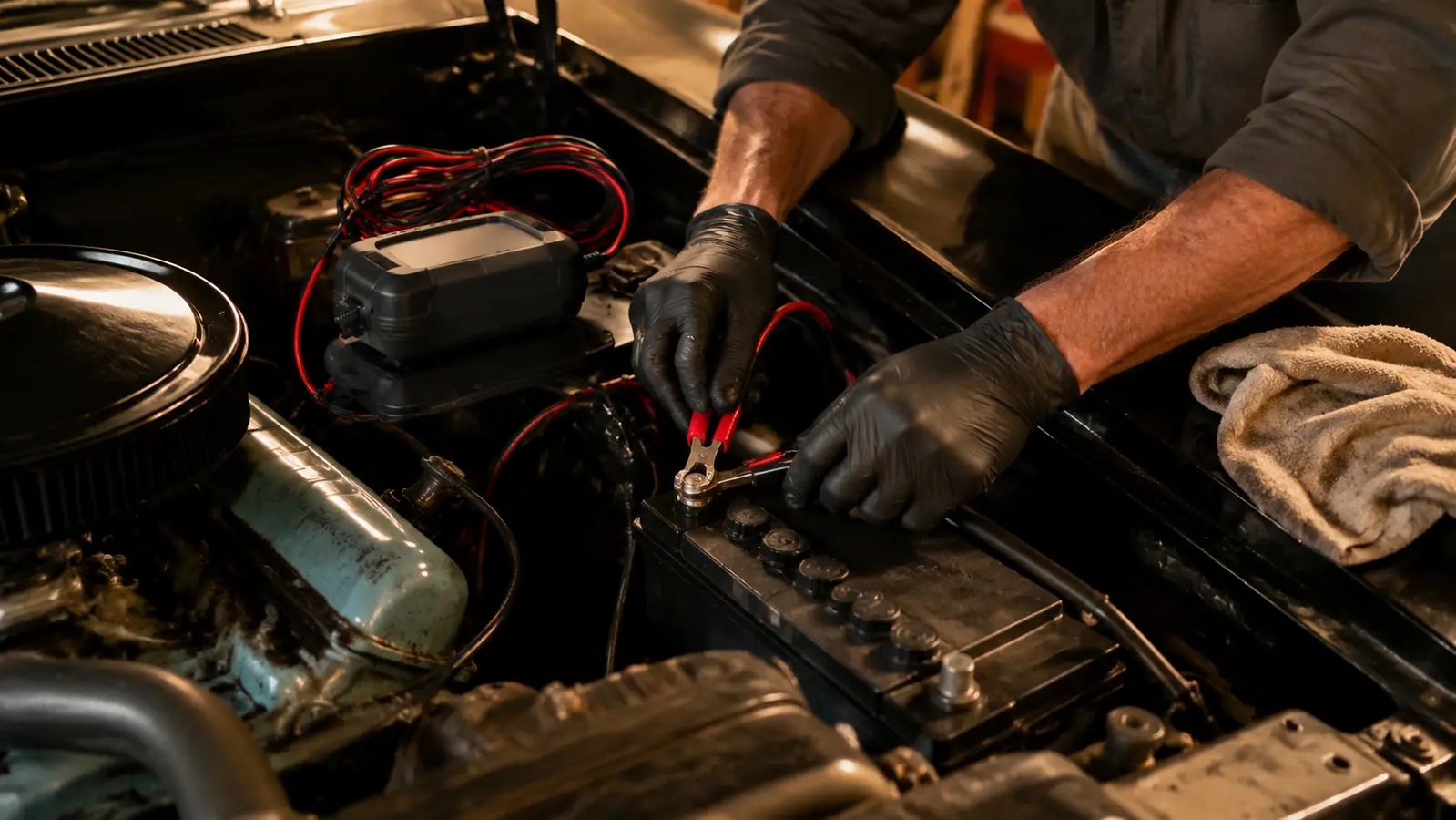
I put the ring terminals on the posts the first week and ran the lead out to the grille so I could reach it with the hood down. The maintainer lives on the wall now. No popping the hood every Sunday, no measuring voltage, no ritual, and no crawling over the fender to reach the posts on the Thunderbird. Brutus and Dottie have knocked over their share of garage clutter, but a wall unit stays out of bulldog range.

The Light Tells You What the Battery Is Doing
The little LED at the top is worth more than half the multimeters I own. Solid while it charges, a blink pattern when it drops back. After a while you read it the way you read the oil pressure gauge. When a battery stops taking a charge the light tells you early, which is the whole difference between planning a replacement and getting stranded. It's dim enough that it doesn't glow the whole shop up at night, which matters when the garage doubles as dog housing.
It Outworks the Parasitic Drain
A classic with an alarm, a memory radio, or a modern ignition box draws a little current even sitting dark, and three or four weeks of that will flatten a battery. The GENIUS1 keeps up with the drain and then floats. My parts truck only moves a couple of times a year, and the battery still reads full every time I climb in. Sitting is the hardest thing a battery does, and this is the one tool that sits shotgun with it.
It Holds Up to a Damp Shop
The clamps have real bite, and the unit sits outside the engine bay, so on the Thunderbird I clip it on with the hood cracked. It has been through a wet winter and a dusty summer on that car without a complaint, and the lead coils back on itself without kinking. I have watched old-school chargers die being hung on the same wall for half as long. It earns its spot on the peg.
It Is the Same Discipline as a Preflight
Before every flight you check the systems, because the item you skip is the one that fails. A tank of fuel and a charged battery is the ground version of that preflight, and a maintainer does the checklist while you aren't even there. Hanging one on a stored car is the closest thing a car guy gets to hangar discipline, and it costs a lot less than a hangar. The discipline transfers.
It Keeps the Cranking Amps Honest
A battery kept on float doesn't just read full, it holds its cranking strength. A battery that's been dragged down and slammed back up all winter will show 12.6 volts and still turn a starter into a sad conversation. The GENIUS1 keeps the first fire of the season sounding like last season, and that sound is worth the hookup alone. You park a classic to enjoy it later, and the first crank of the year is the whole payoff.
What I'd Skip
Now the honest part, because every tool has a line it will not cross. If the car gets driven weekly, or you already pull the battery and keep it on a shelf in the house, you don't need a maintainer. And this one is a 1-amp keeper, not a rescuer. If a battery has been stone dead for six months, start it on a real charger first, then switch to the GENIUS1 once it has got some juice. It will hold what you give it. It won't raise the dead all by itself. And if your battery is past the five-year mark and already weak when it's healthy, no maintainer on earth is going to give it a future.
My F-series killed a battery every winter for a decade. One maintainer and a set of ring terminals put a stop to it in an afternoon.
Give the Battery Something to Do This Winter Besides Die
The NOCO GENIUS1 covers everything I park, six volt or twelve, and the hookup takes ten minutes one time. Whatever you park, don't learn this the way I did.
Amazon Check Today's Price on Amazon →