

If you keep a pre-1955 car, you know the Saturday ritual that is not written down in any restoration book. The old six-cylinder coupe sits for two weeks, you walk out to the garage with your coffee, you turn the key, and the solenoid clicks once instead of catching. Six-volt batteries do not hold a charge sitting the way 12-volt ones do. Mine went from freshly charged to dead as a doornail about every ten days, no matter how new the battery was.
I tried every workaround except leaving the car running. Pulled the battery and set it on my dad's old dumb charger, which meant remembering to kill it before it boiled the electrolyte. Disconnected the ground cable so nothing could drain it, which meant resetting the clock every week and, true story, locking the trunk latch shut with a load of groceries inside. The forums said buy a five-amp charger or just drive it every Sunday whether you need to or not. None of it stuck, and a battery that keeps dying is a battery you keep replacing.
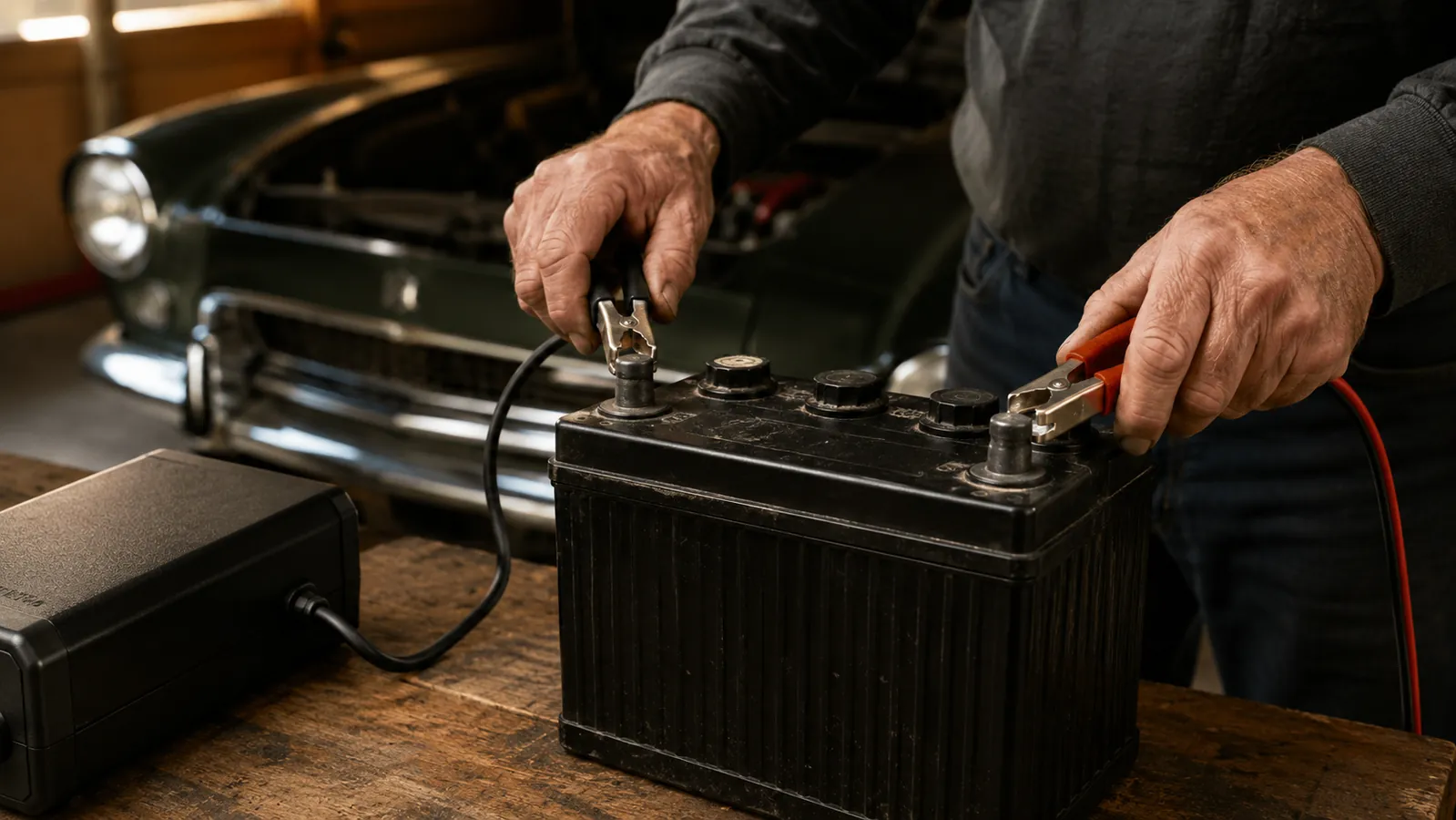
What finally ended the whole ritual was a NOCO GENIUS1 handed across the table at the airfield. My buddy who keeps a 1946 taildragger hangared there gave me the same speech he gives every airplane owner. Never let the battery be the thing that decides whether you fly, or drive. He said this little charger handles six-volt and twelve-volt both, pulls a battery up slow, and then just sits there keeping it full. Then he told me to buy my own and quit using his jump pack.
Here is what I learned once I got it home. The GENIUS1 is a 1-amp smart charger. It will not jump-start anything and it will not resurrect a battery you let sit dead flat for six months, so park the imagination at the door. What it does is exactly the job a six-volt car needs. It feeds the battery a low current, watches the voltage climb, drops to a maintenance float when it is full, and it has a desulfation mode that slowly breaks up the lead sulfate that kills old batteries sitting in garages. It also compensates for temperature, which matters if your shop freezes in January, and it figures out 6-volt from 12-volt on its own. You clip it on, plug it in, and you stop thinking about it.
From dead every ten days to full charge from March through November, and I never once walked out to a coupe that would not crank.
Quit Boosting It Every Other Saturday
A NOCO GENIUS1 handles 6-volt and 12-volt both, and it is the cheapest tool in my garage that works all year without me touching it. Check today's price and end the ritual.
Amazon Check Today's Price on Amazon →I clipped it to the coupe's battery that same afternoon. On my six-volt car the battery lives under the rear seat, where the factory hung it in 1954 and where it has stayed ever since, so I ran the charger lead out the crack in the door jamb, closed the door on the wire (the rubber weatherstrip swallows it fine), and plugged into the outlet over the workbench. The light came on and I went back to the brake job.

I figured I would have to babysit it. Instead, the light went from blinking to solid and stayed there. The next morning the coupe turned over like I had driven it the day before, which I had not. Two weeks later, the same story. The monthly jump-start ritual stopped happening, and I did not even notice until a month went by and I realized I had stopped expecting the battery to be dead.
Here is the part that honestly surprised me. That battery was at least five years old, and six-volt electrical systems usually eat batteries the way a buzz saw eats plywood. The desulfation cycle kicks in when the charger senses a cell needs it, and over the spring the coupe started a little stronger instead of weaker. I am not going to tell you a smart charger brings a dead cell back, because it will not. It cannot put back plate material that a winter of sitting has flaked away. What it does is keep the battery from dying while it sits, and for a car you drive a thousand miles a season, that is the whole battle.
Dottie, my screwy bulldog, knocked the charger off the bench one evening and the clamp popped clean off the post. The coupe sat uncharged nine days before I noticed, and it still cranked fine. Come January, with the garage reading thirty-nine degrees and every other battery in the neighborhood complaining, the coupe lit off on the second revolution. The GENIUS1 had kept that six-volt cell topped all winter, and the slowdown everybody promised me in cold weather never showed up. Last fall the F-series inherited the same charger while it sat through a wet November, and the 12-volt side behaved exactly the same. No switch to flip, no adapter. It reads the battery and gets on with the job.
What I'd Tell You If We Were Sitting at My Kitchen Table
Here is the honest version, because the internet makes this stuff sound like magic and it is not. If your old car sits more than it gets driven, a smart maintainer is cheaper than the next battery, and it is the rare tool you buy, mount, and forget. If your car is pre-1955, make sure the charger you buy supports six volts, because a lot of chargers being made now have forgotten six volts ever existed. Attach the clamps to the battery posts themselves, clean and tight, not to a fender bolt, because a charger is only as good as its ground. And do not expect a 1-amp unit to rescue a battery you let go completely flat for months. That is a job for a new battery, not a maintainer. Keep the charge up while it sits and the car will be ready when you are. I wrote the longer version in my full review of the NOCO GENIUS1, and there is a plain list of reasons a battery maintainer keeps a classic ready that is worth reading before you buy anything.
Whatever Is Sitting in Your Garage
If it is six-volt, one amp is plenty to keep it ready to fire. Check today's price on the NOCO GENIUS1 and stop planning your Saturdays around a jump box.
Amazon Check Today's Price on Amazon →