

The NOCO GENIUS1 is the most-reviewed battery keeper on Amazon at 62,000 and change, and for a guy who works on old iron that usually means one thing: read the fine print yourself. So I ran one for a full year across my shop, on a 1960 F-series that gets driven every few weeks and on a 1954 six-volt coupe that sits parked all winter, and I kept notes on the parts the average review never bothers to spell out.
The short version is that it is a genuinely good smart charger, and also that there are two things about it that will annoy you if you buy it expecting a magic box. Both are easy to work around, provided you know they are coming. That is the whole job of this piece, so let me get to it.
The Quick Verdict
A dependable 1A tender for batteries that are basically healthy. Excellent for storage and for six-volt cars, but not a reviver for a battery you already ran flat.
Amazon Check Today's Price →The Budget Tender That Ends the Monthly Jump-Start
If your classic is parked more than it is driven, a dead battery is the reason why. This is the small smart charger I trust on the whole fleet, and today's price is a whole lot cheaper than a tow truck.
Amazon Check Today's Price on Amazon →How I've Used It
I run two of them, one per car, because the collection does not share a tender well. The F-series gets a GENIUS1 on the battery all through the months it sits, and the coupe gets its own on the six-volt side. The clever part of the NOCO is that it will read the battery and pick six or twelve volts on its own, which matters more than most people realize once you own a pre-1955 car.
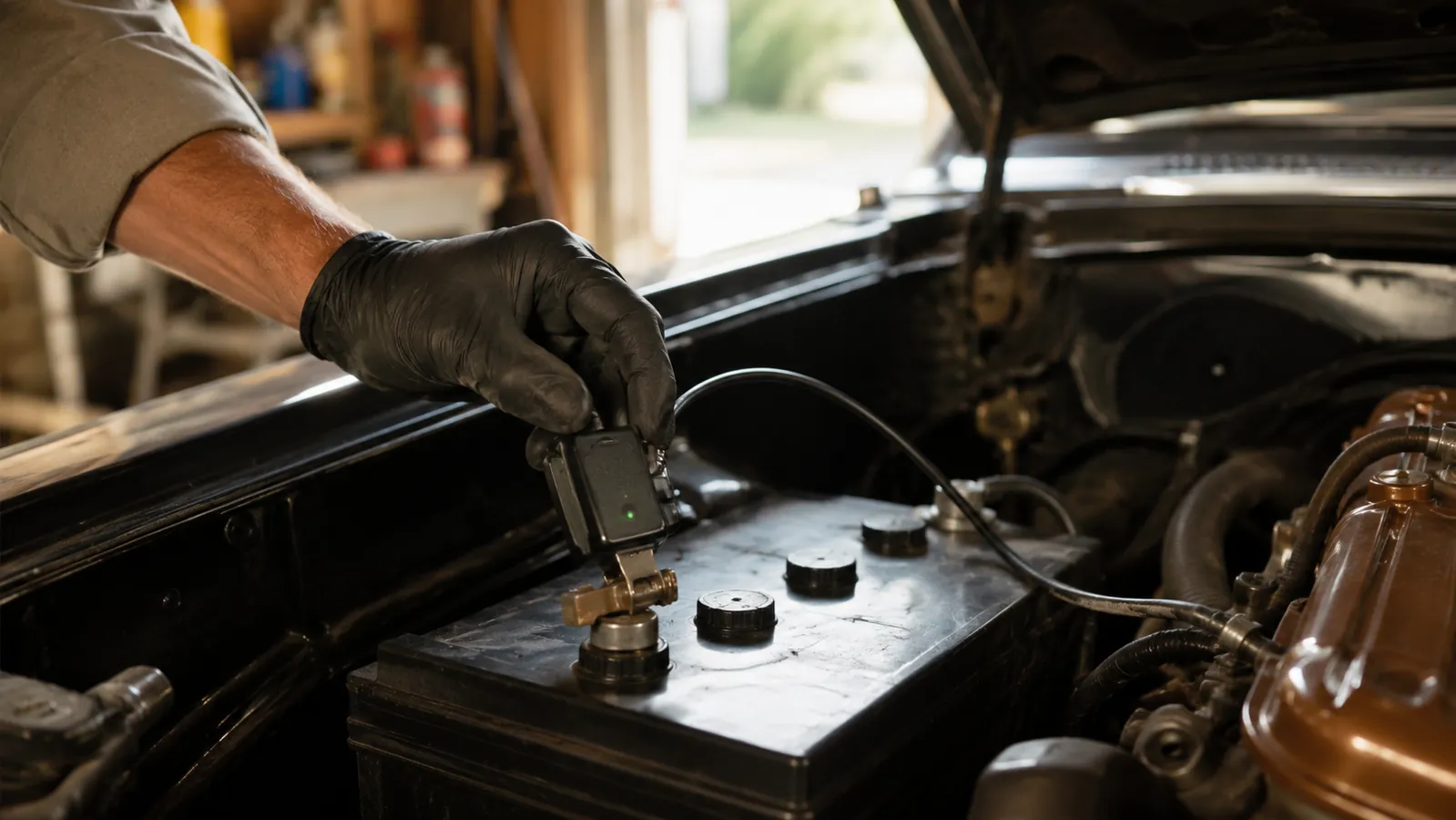
For the winter I leave them clipped on with the eyelet terminal kit, which is a small set of ring terminals that bolt to the battery posts and let you plug the charger in without reaching for the clamps every day. On the F-series I can just lift the hood, plug the little lead in, and walk away. On the coupe the battery is under the floorboard, so the ring terminals are not a convenience, they are the only sane way to do it.
A normal week looks like this: the cars sit, the chargers sit there doing nothing, and when I do fire one up it cranks like it was driven yesterday. That is the whole point of a maintainer, and the GENIUS1 does that part about as well as anything I have used in thirty years of messing with old iron. Brutus and Dottie seem to agree, or at least they have never complained about the quiet hum it makes.
The First Thing Nobody Mentioned: The Clamp
Here is the detail that the 62,000 reviews dance around. The clamps on the GENIUS1 are decent, but they are not the chunky marine-style jaws you might picture, and they can be fussy on an old battery post that has a bit of corrosion or a dirty terminal. I wire-brush my posts every fall, so it has never actually left me stranded, but the first time you clip on and the little LED stays red instead of green, resistance in the connection is the usual culprit.
The fix is simple and it is the same fix you already use for everything else on a classic car: clean the terminal. A clean post and the clamp grabs fine and the charger does its thing. I should also mention that the cable is on the short side, so you will want to mount the unit within reach of the battery or plan to run the eyelet kit. Neither is a dealbreaker, but they are the sort of things that would surprise you if you bought this based on the Amazon page alone.
The 1A Ceiling Is the Real Story
This is the honest part most reviews skip. The GENIUS1 pumps out 1 amp, and that number decides everything about what this tool is for. One amp is plenty to hold a healthy battery at full charge through months of sitting, and it will gently top off a battery that is only a bit low. But it is not a charger in the way a 10 amp unit is a charger, and if you drain a battery hard, the GENIUS1 will take a very long time to bring it back.
I found this out the hard way one March when I left the parking lights on the F-series and killed the battery flat. The GENIUS1 read it, dropped into its bulk charge mode, and started feeding at that 1 amp ceiling. It took the better part of two days to get back to a state where the truck would crank. It did get there, and it did not hurt the battery, but I will not pretend it was quick.
So the honest take is this. If your battery is basically healthy and just needs to not die over the winter, the GENIUS1 is perfect. If you are trying to revive a battery you have already run down to nothing, put it on a bigger charger first, then let the NOCO keep it alive. Buy it for the keeping, not the reviving, and you will not be disappointed.
Six-Volt Support Is the Hidden Win
The single best thing about this unit for a classic car guy is that it does six volts. A lot of tenders on the shelf are 12V only, and for a 1954 six-volt electrical system that makes them useless. When I bring a car like that home, the battery is usually dead and the wiring is a mystery, and being able to hand it a proper 6V charge without buying a second dedicated charger is a real convenience.
It reads the voltage and picks the right mode automatically, so there is no switch to get wrong, which is exactly what you want when you are leaning over a fender with your reading glasses on. On the coupe it has held the six-volt battery through two winters without complaint, and the battery still tests strong in the spring. If you only ever work on 12V cars, that is fine, but the 6V support is the feature that makes me keep reaching for it.
Mounting and the Eyelet Kit
The GENIUS1 is small enough to live on a shelf or a bench, and NOCO sells a proper bracket if you want it screwed to the wall. I have one on a painted wall above my bench and one on a shelf, and the little unit takes up almost no room, which surprises people who have only seen the big yellow boxes. It stays cool, it is quiet, and after a year not one of mine has shown a complaint.
The eyelet terminal kit is worth the few extra dollars and it is the mounting upgrade I would actually pay for. You bolt the ring terminals to the posts once, and then every charge is just clicking the connector on. On a car with an awkward battery location, that is the difference between actually using the tender every sitting and letting it gather dust because getting at the terminals is a chore.
One warning before you mount it near the battery. The GENIUS1 is rated for the battery, not for the car, so it is worth checking your manual on electronics and whether a maintainer is safe to leave connected to a car that has an old computer or alarm system. On the classics I run, that is not a concern, but on a newer daily driver it is the kind of thing a careful owner checks before leaving it plugged in all season.

Overcharge Protection, Temperature Compensation, and Desulfation
All the smart-charger traits are there, and they are the reason I trust it to stay clipped on for months unattended. It compensates for cold, so it does not overcharge in the winter garage, and it goes through its charge-maintain cycle without cooking the battery. The desulfation function is a nice-to-have on an older battery that has been sitting, and it is part of why the coupe's battery has lasted as well as it has.
None of this is hype, it is just the reason a maintainer is a different animal from a dumb charger. A cheap trickle charger will boil a battery dry if you leave it on too long, and that is exactly the failure the GENIUS1 is built to avoid. Leave it on for five months and it will still be doing its quiet job when you come back in the spring.
What Else I Tried Before This One
Before the NOCO I was using a classic float charger that I had owned for years, and it worked fine until it did not. That is the thing about old-school trickle chargers. They work until you forget to unplug them, and then they cook the battery and you learn the lesson. The GENIUS1 is the first smart charger I have owned that I actually trust to stay on the battery without checking it every week.
I also tried a cheap no-name unit from a parts store that was supposed to be a maintainer. It lasted about six months before the LED started flickering and I stopped trusting it. The NOCO is built better than that, and you can feel it in the weight of the case and the way the connectors fit. It is not a splurge, it is a buy-it-once piece of kit.
There is also the question of what happens when something goes wrong. I have not needed warranty support on mine, and I have not heard enough bad stories to worry about it, but it is worth knowing that NOCO backs these units with a warranty that runs longer than you would expect for the price. In a hobby where parts fail quietly, that is not nothing.
A Year In: What Has Held Up
After twelve months of real use, the only things that still bother me are the same two things that bothered me on day one: the short cable and the 1A ceiling. Both are design choices rather than defects, and both are solved by how you mount the unit and what you expect from it. Nothing has worn out, nothing has stopped working, and the little green light has been a reliable signal all year.
The best compliment I can give it is that I stopped thinking about it. A battery maintainer should be the most forgettable tool in the garage, the one you never have to run to the parts store to replace. After a year, the GENIUS1 is exactly that, and for a guy who has owned his share of finicky charging gear, that is the highest praise I have.
It also has a place in the airplane side of my life, where the same lesson applies. A battery that is kept charged and warm is a battery you can trust when you need it, and the principles are identical whether the part holding things together is a car or an aircraft. Good prep, patience, and not skimping on the thing that starts the engine.
What I Liked
- Does six volts as well as twelve, which most tenders will not
- Small, quiet, and safe to leave on for months unattended
- Eyelet terminal kit makes charging easy on awkward batteries
- Temperature compensation and overcharge protection done right
- Desulfation helps keep an old battery alive a little longer
- Auto-detect voltage, no switch to forget
Where It Falls Short
- 1 amp ceiling is a maintainer, not a quick charger
- Clamps can be fussy on a dirty terminal until you clean the post
- Short cable, so mounting has to be close to the battery
- Too slow to bring back a battery you already ran flat
For a battery that is basically healthy and just needs to not die over the winter, the GENIUS1 does its job about as well as anything I have used. The catch is that it is a tender before it is a charger, and too many people buy it expecting the second.
Who This Is For
Buy the GENIUS1 if you own a classic that sits more than it is driven, and especially if that classic is a six-volt car. It is the right tool for the person who wants to walk into the garage in spring, clip on a tender, and have the car crank like it was parked yesterday instead of playing the jump-start-and-pray game. If you have more than one car to keep alive, they are cheap enough that you will want one per battery rather than shuffling a single unit around.
It is also a good fit if you are the sort of person who wants to set something up and forget about it. The automatic voltage detection, the temperature compensation, and the desulfation cycle all work in the background. You do not have to think about it. The battery just stays ready, and that quiet dependability is worth more than a flashy spec sheet.
Who Should Skip It
Pass on it if your real problem is a battery that is already dead and you need it back on the road this afternoon. At 1 amp it is simply too slow for that job, and you will stand in the shop staring at a red light for days. Get a proper higher-amp charger for the revive, and use the GENIUS1 for what it is actually good at, which is keeping a healthy battery healthy.
I would also say skip it if you never let a car sit long enough to kill a battery. If you drive your car every day, a maintainer is not a tool you need, and spending the money on one is just buying a solution to a problem you do not have. And if you want a single unit that can both revive a dead battery and keep it alive, the GENIUS1 is not that. You would want a higher-amp model for the revive part.
Keep the Collection Ready Without the Ritual
After a year on old iron, this is the tender I trust on the whole fleet, six-volt and twelve alike. Check today's price and put an end to the monthly jump-start for good.
Amazon Check Today's Price on Amazon →