
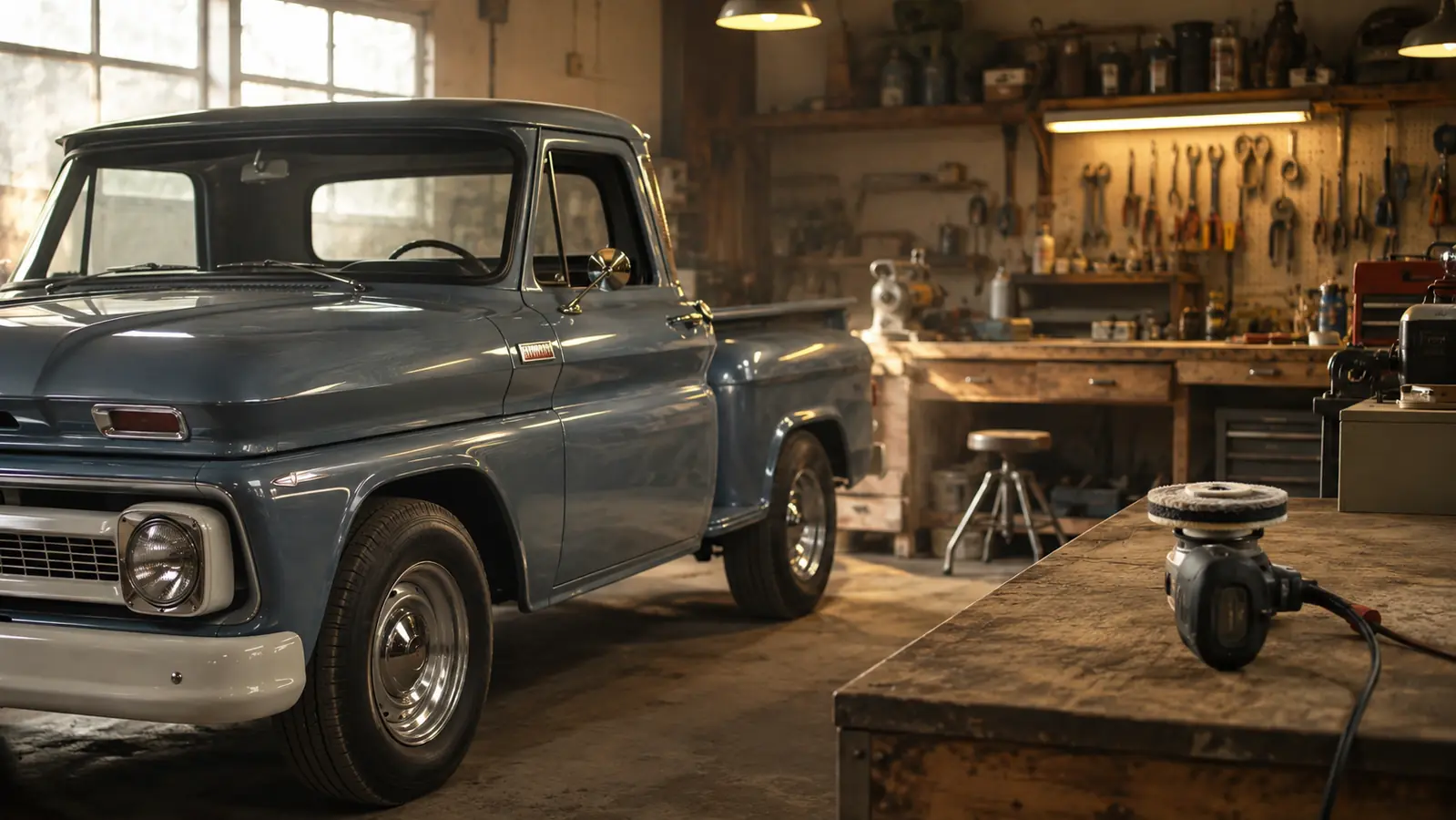
You know the arm ache. You know standing beside a fender with a foam pad in your hand, working a compound in small circles until your shoulder starts to complain, and the oxidation on a single-stage job just laughs at you. I did two weeks of that on the 1960 F-series before I finally admitted the problem was not the compound and not me. It was my arms. A man in his late fifties does not out-will a chalky single-stage hood with elbow grease.
So this is the honest review of the tool that ended that. I have run the AVID POWER six-inch dual action polisher for a full season of weekend paint work across three old cars, which is a better test of a budget machine than any two-hour session. Here is what it will do for your paint, what it will not, and the two places it reminds you it is a budget tool.
The Quick Verdict
The best-value tool a weekend detailer can pick up. It cut oxidation and fine swirls out of old single-stage and clear-coat paint without burning a single panel, and it is forgiving enough for a first machine.
Amazon Check Today's Price →Stop Polishing Faded Paint by Hand
If you have a chalky hood or a swirl-marked fender and you are still doing it with your arms, this is the tool that ends the elbow grease. A dual action machine is forgiving on old paint, which is exactly what a beginner needs.
Amazon Check Today's Price on Amazon →How I've Used It
The machine is a multicolored dual action orbital polisher, six inches, six speeds, that comes in a molded case with three foam pads, a backing plate, and a detachable handle. Out of the box it is lighter than I expected, somewhere around seven pounds, which matters when you are holding it over a fender for twenty minutes. The first thing I did was drop the handle screw into the garage floor and spend ten minutes finding it under the workbench, so hang onto that hex wrench.
Over the season I put it on three very different surfaces. The F-series had single-stage paint that had gone flat and chalky on the hood and roof. The six-cylinder coupe had a fairly modern clear-coat job with a lining of fine swirls from years of machine washes. And the Thunderbird, which belonged to nobody in particular, had a hood that needed a full cut and then a polish. I ran it with a cutting compound first, then a finishing polish, then wax, on speed settings from two up to five. The machine never overheated, never threw the pad, and the side handle kept my grip steady on the roof.
The dogs, Brutus and Dottie, watched from the folded blanket on the floor the whole time. Brutus is not a paint dog, but he is a polisher supervisor, and he did not complain about the noise once. The machine is not loud. It hums, it does not scream, and after an afternoon of passes I could still hear out of both ears, which counts for something in a garage.
What Comes in the Case
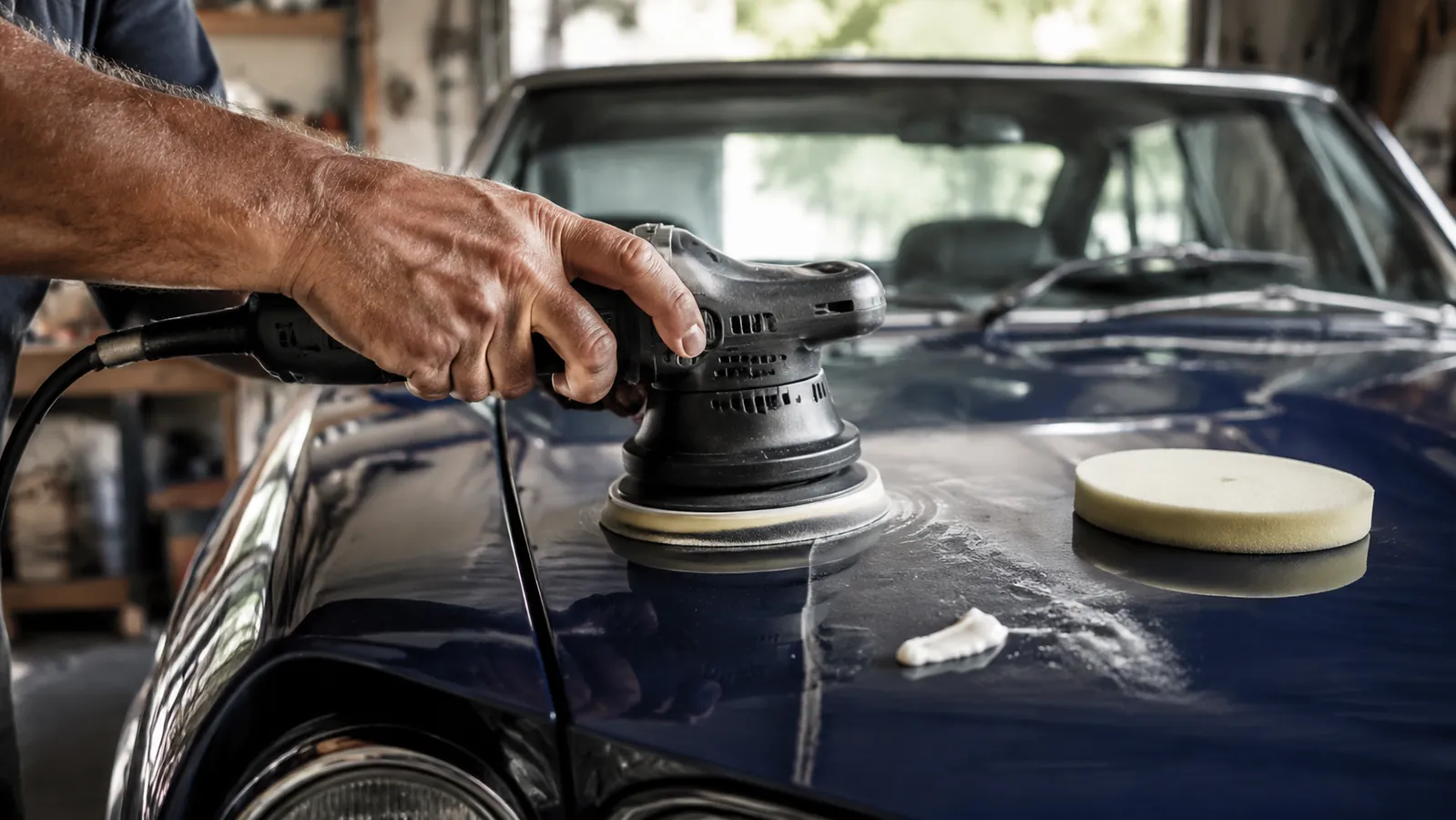
Before you ask what you still have to buy, let me be straight about the box. For the price, the kit is generous. You get the machine, a six-inch backing plate, three foam pads in cutting, polishing, and finishing grades, a detachable side handle, a hex wrench for the arbor, and a hard molded case that stacks up neatly on a shelf. The case is stiff and the pads are held in their own foam. That may not sound like much, but it is the difference between a tool that lives in a drawer and a tool that ends up with a layer of grime on it.
What you still need is a separate compound and polish, because the kit does not include any product, and unless the backing plate is already fitted you will want to seat it on the arbor before first use. Fit the plate, then the pad, then practice on a junk panel before you touch a fender you care about. That practice panel is the best advice I can give with any new machine, and it cost me nothing but a scrap of sheet metal and twenty minutes.
What the Machine Actually Does to Faded Paint
Here is the honest math. On the F-series hood, two passes of compound on a cutting pad at speed four took the chalky gray out and brought the color back to the point where a neighbor asked if I had resprayed it. I had not. It was the same paint that had been sitting in the sun for years, just cut back a couple of thousandths. On a single-stage car, a dual action machine gently removes the dead oxidized layer instead of scrubbing at it with your palm.
On the coupe's clear-coat, the swirls came out with a lighter pad and a finishing polish. That is the safest use of a DA on a modern clear job, because the oscillating motion is the whole point. A rotary spins in one direction and can burn through if you linger. A dual action moves in a random orbit, so the pad never lingers over the same spot and the paint stays cool. That random orbit is why I trusted it on paint I did not want to repaint.
The key is the speed. I kept the cutting passes at speed four, not six, even though the machine will spin faster if you ask it to. Faster is not better on aged paint. A slower, longer pass with light pressure and the pad working the compound is what brings the surface back without stripping it. The AVID POWER gives you all six speeds, and the discipline to use the lower ones is what keeps single-stage paint alive. That is the part the reviews never say, and it is the part that matters.
In a full season of cutting, polishing, and waxing three old cars, the AVID POWER DA never burned a single panel. That is the whole argument for a dual action machine over a rotary, and it is the reason I would hand this one to a beginner.
Vibration and Comfort Over an Afternoon
If you have ever held a cheap rotary for an hour, you know vibration is not a nitpick, it is the thing that makes you quit. The AVID POWER vibrates, but it is a controlled, low-frequency hum rather than a buzzy shake. With the side handle on, I could work the door panels and the roof with both hands and the machine tracked where I aimed it. The detachable handle is a real selling point, because removing it lets you reach into the tighter spots without the handle catching the body line.
After a full afternoon on the Thunderbird, my forearms were tired the way you want them to be tired after legitimate work, not the numb, dead-fingered feeling a bad machine leaves you with. The cord is the one ergonomic miss. It is on the shorter side, so I had to move the extension lead around the car a few times to keep it out from underfoot. That is a small annoyance at this price, and worth knowing before you start so you are not cussing a tangle halfway down a fender.
The Two Places It Reminds You It's a Seventy Dollar Tool
I promised you honest, so here are the two. First, the machine stalls under hard pressure on the lowest two speeds. If you lean on it at speed two, it stops spinning and just vibrates until you back off. The fix is to work at the right speed and let the pad do the cutting, which is exactly what you should do anyway. But if you are used to a big rotary that pushes through anything, this will feel like a machine that gives up. It does not. It is telling you to ease up.
Second, the three pads that come in the kit are entry level, and they will not last a full season of serious cutting. The cutting pad glazed over on me about halfway through the work, and I replaced the pads a few weeks in with better foam discs. That is not a knock on the machine. The bare tool is the value, and nobody should expect a seventy dollar kit to include forever pads. Budget to buy a couple of good pads and you are set. The machine itself showed no sign of wear after the whole season.
The Finish It Leaves
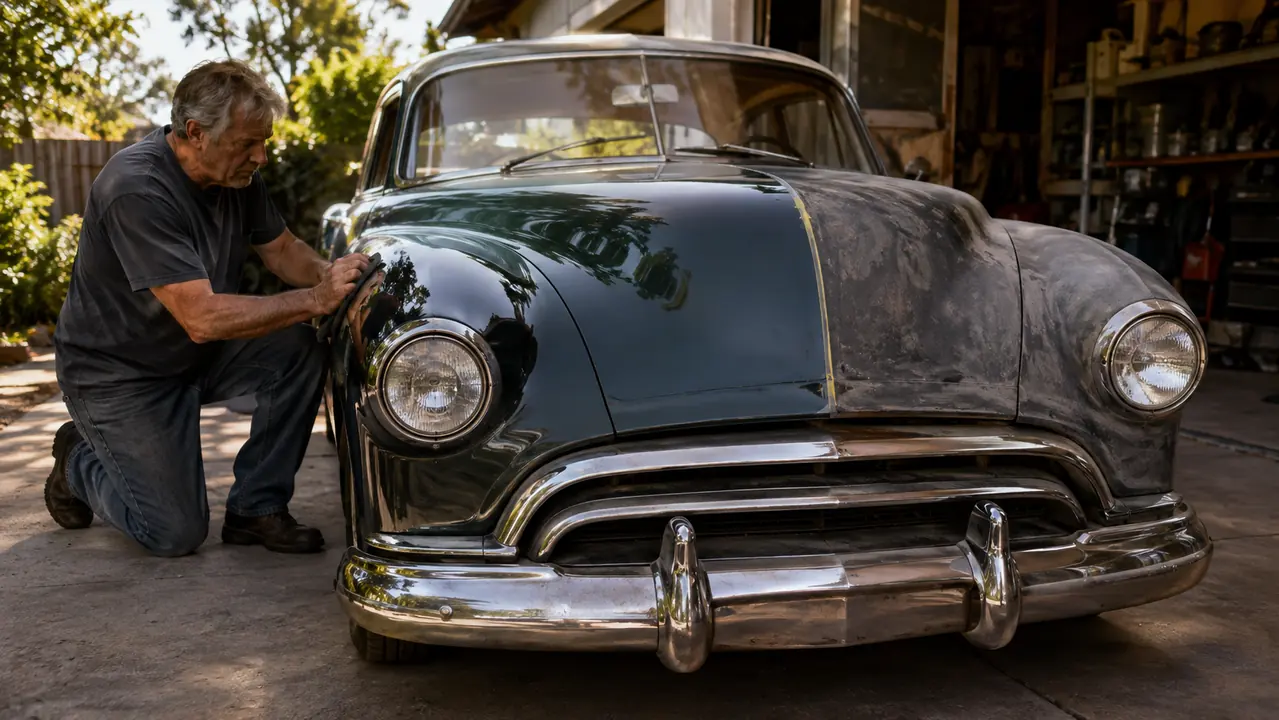
The payoff is the finish, and this is where the tool earns its keep. After the cut, the polish, and a wax pass, the F-series hood held a wet shine for weeks, and the color was richer than I had seen on that truck in years. The coupe's clear-coat looked like it had been professionally detailed, flat and deep, with no trace of the swirls. It is the difference between waxing a dirty oxidized surface and sealing a clean one.
There is a discipline to it that reminds me of hanger work, actually. Prepping an airplane surface, you do not skimp on the part that holds things together, and you do not rush the passes. Same with a fender. You work small sections, you keep the pad flat, you let the machine do its job, and you do not chase the last thirty seconds. The AVID POWER rewards patience, which is a good thing for a weekend restorer to practice. And it is a good thing for the paint, because patient passes are what give you a finish that lasts instead of one that flashes bright and dulls in a month.
What I Liked
- Forgiving dual action motion, very hard to burn through old paint
- Six speeds cover cutting, polishing, and waxing with one machine
- Light and comfortable, with a detachable side handle for vertical panels
- Comes ready to go with a case, three pads, and a backing plate
- Quiet enough to run in the garage without ear protection for short stints
- A fraction of the price of the enthusiast DAs and good enough for weekend work
Where It Falls Short
- Stalls under hard pressure on the lowest two speeds
- The included pads are entry level and need replacing with serious use
- Cord is on the shorter side, so you will move the extension lead around the car
How It Compares to the Bigger DAs
If you are wondering whether to spend three times as much on a name-brand machine, here is the plain version. The expensive DAs are smoother, they do not stall under pressure, and their pads last longer. If you detail cars for a living, buy the expensive one. If you are a weekend guy with one or two old cars, the AVID POWER does the same job well enough that the difference shows up mostly in the finish of your weekend, not the finish of your paint. I have not felt the urge to upgrade, which is the honest test of a budget tool.
The place the gap does show is pad quality and the stall under hard pressure, both of which I have covered. Neither stopped me from getting a show-quality shine on three cars. For the money, the AVID POWER is the machine I would recommend to a neighbor who is tired of hand-polishing and has a paint job he is nervous about. The dual action motion takes the fear out of it, and that is worth more than extra power you will not use.
Who This Is For
This machine is for the guy with one or two old cars who is tired of polishing by hand and does not want to spend a small fortune on a tool he will use a dozen times a year. It is for the beginner who has heard horror stories about rotaries burning through single-stage paint and wants the safety of a dual action. If you are cutting oxidation, chasing swirls, or just trying to get a wax on without the arm ache, the AVID POWER is the honest answer.
Who Should Skip It
If you are a professional running a two-car or three-car a day detail operation, do not buy this. A pro needs a machine that refuses to stall at any speed and pads that last a week, and that means spending real money on a higher-end DA. And if you are doing heavy correction on deep scratches or wetsand damage, you are out of this tool's lane. For a hobbyist, it is the right tool. For a working shop, it is a spare, not a main.
Put Your Arms Back to Work on Something Else
A season of cutting, polishing, and waxing three old cars taught me this machine is the best value in my detailing drawer. If your paint is faded and your shoulder is sore, give the AVID POWER DA a weekend.
Amazon Check Today's Price on Amazon →